


The Embassy of the Republic of China (Taiwan) in Saint Lucia has officially handed over the Kwéyòl-English Online Dictionary to the Msgr. Patrick Anthony Folk Research Centre (FRC). The application was developed by Mr. Jimmy Chiu, who was an ICT intern at the Taiwan Technical Mission (TTM) in Saint Lucia from August 2025 to January 2026.
The Kwéyòl–English Online Dictionary currently contains 10,553 words. However, it is hoped that local Kwéyòl language specialists will collaborate to expand, update, and correct entries over time. Further, ongoing technical maintenance will also be crucial to ensuring that the system functions smoothly.
On Tuesday, January 20, 2026, the Taiwan Embassy, in collaboration with Msgr. Patrick Anthony Folk Research Centre (FRC), hosted a technical workshop at Barnard Hill, Castries, where Mr. Chiu shared his knowledge of the software, demonstrated how the dictionary works, and guided those in attendance on how the system can be maintained. That workshop was held just days before Mr. Chiu’s five-month stint in Saint Lucia ended.
During the official handover ceremony held on Thursday morning, April 2, 2026, at the Msgr. Patrick Anthony Folk Research Centre (FRC) at Barnard Hill, Castries, H.E. Nicole Su, Taiwan’s Ambassador to Saint Lucia, noted that since her arrival in Saint Lucia in January last year, she had observed that online learning resources are relatively limited. While the Google Translate app features Haitian Creole, Seychelles Creole, and Mauritius Creole, she said Saint Lucian Creole was absent.
“I feel that it is a huge pity that the rest of the world is deprived of the opportunity to learn and appreciate the richness of Kwéyòl St. Lisi,” Ambassador Su said. “As it is part of your precious cultural heritage, I feel strongly that it should be preserved and made accessible for future generations.”
She said she was able to take advantage of the dictionary published by the Ministry of Education in 2001, a copy of which was given to her by Senator Embert Charles and the FRC.
Ambassador Su thanked the Taiwan Technical Mission for the online system, especially Mr. Chiu, who used the print version of the dictionary to develop it into an online system.
“Not only did he develop the software, but he also painstakingly entered every word from the print, making them available online,” Ambassador Su said. “Further, Jimmy also utilized the rich collection of phrases in that dictionary and artificial intelligence to try to develop the translation function. Obviously, that translation is the trial version and the best he could do.”
Ambassador said the Taiwan Embassy was pleased to officially hand over the online dictionary to the FRC, adding that, with Chiu’s consent, all intellectual property rights are being waived, so that the FRC could further maintain, utilize, and expand it. She added that the overall goal is to make learning the Kwéyòl language accessible to a wider audience, including to students, teachers, and the general public, and ensure that Kwéyòl St. Lisi remains vibrant and relevant.
“Although this started as my pet project, I think you would agree with me that the significance of this project is beyond just an online dictionary,” she stated. “It is about the preservation of your culture. Of course, there’s no need to worry that Kwéyòl St. Lisi would vanish someday as it is still very much alive and highly cherished. However, language is just one aspect of the manifestation of your culture.”
In the age of digitization, Ambassador Su underscored the need for digitization of culture, so that Saint Lucians can claim sovereignty over their culture during the rapid development of artificial intelligence (AI).
“The ‘AI sovereignty’ is a new concept,” she said. “In simple terms, we must make sure that any output generated by AI shall reflect the proper Kwéyòl St. Lisi culture. I think this dictionary could be the first step leading to a bigger AI project because we must start somewhere. Taiwan is honoured to work together with you for the preservation and promotion of culture.”
Hon. Dr. Ernest Hilaire, Deputy Prime Minister and Minister for Tourism, Commerce, Investment, Creative Industries, Culture and Heritage, said the handover ceremony was timely, occurring during the same week when Saint Lucia submitted documents to UNESCO for the La Rose and La Marguerite flower festivals to be added to UNESCO’s List of Intangible Cultural Heritage.
“Today’s event is a very powerful addition to the establishment of an understanding and acceptance globally of our cultural identity,” he said. “At a time when the world is moving so rapidly towards the use of AI to establish the identity of people by what is presently online, this is a valuable addition. When people are seeking to find out about Saint Lucia and who we are as a people – our characteristics and personalities – and they use AI search engines, at least there’s some connection with an authentic expression as contained through this app.”
Hon. Dr. Hilaire explained that AI is rapidly taking over the global use of information, and that Saint Lucia cannot be left behind. He said many people rely on these applications for to gather information, warranting what comes up as Saint Lucian to be authentic. He added that he looks forward to collaborating with the Taiwan Embassy on a proposed ‘Sovereign AI’ project focusing on cultural heritage.
“I want to, on behalf of the Government and people of Saint Lucia, express sincere thanks to the Government and people of Taiwan, for giving this to us, and look forward to our work on ‘Sovereign AI’, and how we can advance that project,” Hon. Dr. Hilaire stated.
Meanwhile, Msgr. Dr. Patrick Anthony, Founder of the Folk Research Centre, also spoke at the ceremony, saying the FRC remains a research institution tasked with spearheading authenticity. In today’s a world, where people are exposed to alternative facts and alternative truths, he said FRC’s role becomes more essential.
“In a world of AI, you never know what can happen to Saint Lucia’s identity, image, history, and language, because others can take it and do whatever they want with it,” Msgr. Dr. Anthony said. “We are the ones who have to define who we are and document what we have. We are the ones who have to find a way in which we gather our own knowledge and consciousness and pass it on, so that others who come afterwards can see where we’re going.”
Msgr. Dr. Anthony said the FRC was pleased to have the Taiwan Embassy as a partner helping the FRC to use the current technology to showcase crucial aspects of Saint Lucia to the rest of the world. He also issued an appeal for interested partners as the FRC plans to rebuild its former building at Mt. Pleasant that was destroyed by fire in March 2018.
Mr. Jimmy Chiu, developer of the online dictionary, attended the official handover ceremony virtually, and presented his experience working on the Kwéyòl Dictionary project in Saint Lucia. He highlighted the challenges of developing technology that accurately reflects local language needs and cultural context. He also explained how the team worked to create an accessible app that was handed over to local partners, including FRC and the Kwéyòl Committee, along with full maintenance assets and back-end code.
Mr. Chiu expressed pride in the project’s impact on preserving the local culture and language, emphasizing how the technology diplomacy approach left capabilities with local people while making a real difference in the community. He also said that through developing the app, he was able to give back to Saint Lucia, the country that has given him great memories and experiences.
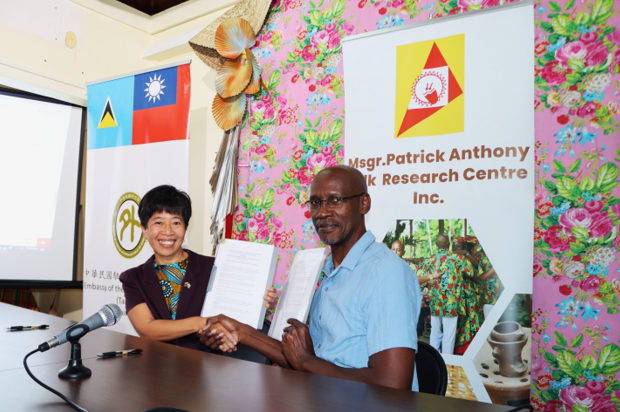
During the ceremony, Ambassador Su gave a practical demonstration on how the Kwéyòl-English Online Dictionary works, before signing a Letter of Cooperation with Hon. Embert Charles, Senator and Chairman of FRC.
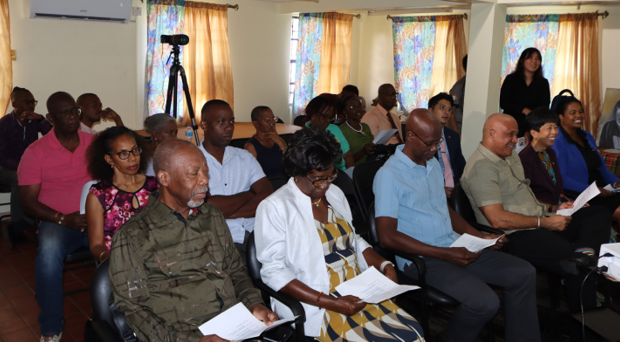
Other attendees at the official handover ceremony included Hon. John Paul Estephane, Minister in the Ministry of Tourism, Commerce, Investment, Creative Industries, Culture and Heritage; H.E. Dame Pearlette Louisy, Governor General Emeritus; Mr. Daniel Lee, Chief of the Taiwan Technical Mission (TTM) in Saint Lucia; Mr. Melchior Henry, Acting Executive Director of FRC; and Members of the FRC and the Kwéyòl Language Committee.
SOURCE: Embassy of the Republic of China (Taiwan) in Saint Lucia