


The Taiwan Technical Mission (TTM) in Saint Lucia recently hosted a training workshop that focused on pineapple cultivation. The aim of the workshop was to encourage more farmers to cultivate the fruit crop, thereby enabling them to not only reap economic benefits but also help reduce imports of pineapples.
The workshop was held in Grace Woodlands in Vieux Fort on Thursday, April 23, 2026, where several farms are owned and operated by farmers from the south of the island. Participants included extension officers, farmers, and the TTM team.
During the first hour of the three-hour workshop, participants were able to gain a wealth of knowledge from one another related to pineapple cultivation and its health benefits, including technocrats, who shared their knowledge.
Mr. Moses Rene, who owns a pineapple farm at Grace Woodlands, has been farming for over 20 years. During the demonstration, he shared his experiences and challenges related to pineapple cultivation.
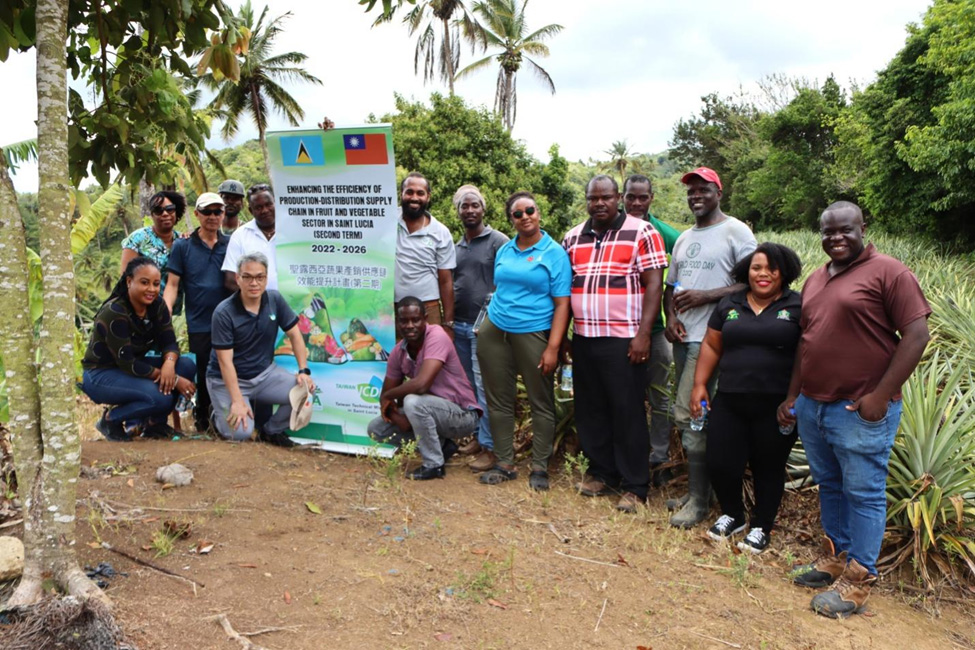
Mr. Rene is a major supplier of pineapples in the local market and has in-depth knowledge of pineapple cultivation. He said proper soil preparation is a crucial aspect of pineapple cultivation. However, the crop does not require much irrigation and use of fertilizers. However, proper drainage is necessary.
Compared to banana cultivation, Mr. Rene said pineapple cultivation is more lucrative and demand is usually high for pineapples, especially from local supermarkets and hotels, who are his principal buyers. He encouraged farmers to diversify their business models to incorporate pineapples, adding that most hotels are forced to import pineapples because local farmers cannot meet the high demand.
“If you get it right, you’ll be a smiling farmer because the demand is there and it pays very well,” said Mr. Rene. “Also, pineapple cultivation is not as labour intensive as banana cultivation.”
Another farmer, Mr. Adrian David, from Choiseul, has been farming for over 20 years. He said a one-acre farm typically accommodates around 12,000 pineapple plants, each costing around $2.00. He explained that the crop can likely produce more than $50,000.00. Moreover, planting material obtained from the initial cycle eliminates the need for buying planting material for subsequent crops.
The participants also toured Mr. Rene’s farm and that of Mr. Peterson Victor, who also cultivates a vast expanse of pineapples. The TTM team also presented rolls of plastic ground cover to the farmers as tokens.
Popular pineapple varieties in Saint Lucia include Antiguan Black, Bouteille, Smooth Cayenne, and Victoria Sweet. Pineapples are highly nutritious in vitamin C, vitamin B6, copper, potassium, magnesium and iron. They also contain antioxidants, may aid digestion, and may reduce the risk of cancer.
Mr. Edward Wilson, Production Officer with the Seven Crops Project at the Taiwan Technical Mission (TTM), said the training was conducted primarily to ascertain what interventions the Seven Crops Project can make to strengthen potential farmers in the pineapple production sector. In the past, he noted, the Seven Crops Project had highlighted that the high importation of pineapples, especially from Costa Rica and Colombia, remains a concern, especially given the fact that pineapples can be produced locally. However, other challenges remain.
“One of the issues the hotels – which are the main market – highlighted is that of the ‘deep eye’, which is found mainly in the Antiguan Black variety, and interventions in helping out the pineapple situation have not been that forthcoming in recent years,” he explained. “This is why we specifically did this training by bringing the farmers to an actual pineapple farm to see first-hand what’s happening on the ground.”
Mr. Wilson said due to the negative impacts caused by climate change, many banana farmers have abandoned their plantations. This, he said, presents an opportunity for them to diversify.
“We know that the mono-cropping system in Saint Lucia has increased acidity levels in soils. However, pineapples will still thrive in soils that are acidic. So it’s good to diversify, especially in soils that have been cultivated with banana for years,” Mr. Wilson explained.
Despite the challenges being faced by farmers, Mr. Wilson said the Seven Crops Project will be seeking whatever further support it can give to new farmers, including new planting material.