


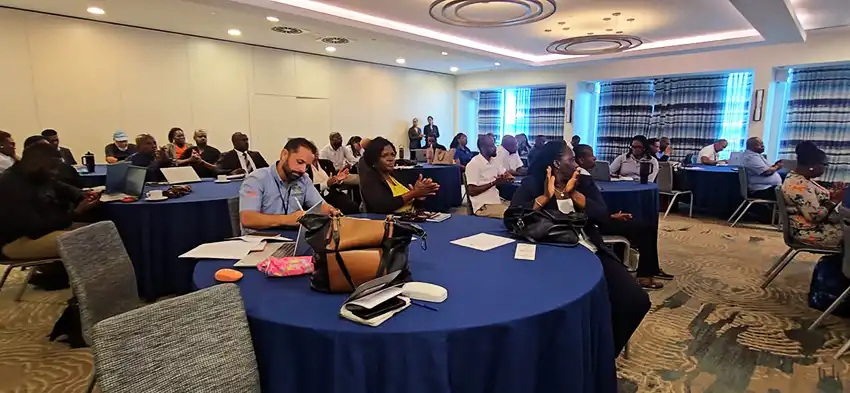
Saint Lucia has moved closer to establishing its first National Occupational Safety and Health Policy, as representatives from government, employers, workers and other key sectors convened to review and validate the proposed framework for safer and healthier workplaces.
Led by the Department of Labour, the National Occupational Safety and Health (OSH) Policy Validation Workshop brought stakeholders together on July 30, to review the draft policy, identify areas for further consideration and recommend measures reflecting the realities of Saint Lucia’s working environment.
The policy-development process began in 2024, when the Department sought assistance from the International Labour Organization to revise an earlier policy drafted in 2017. Following a review of the document, a gap analysis was recommended to account for changes in the national workplace environment and current international standards.
Occupational safety and health consultant Quincy Jones was subsequently engaged to develop a national profile assessing the country’s existing systems, resources and challenges. The findings informed the draft policy presented to stakeholders for validation.
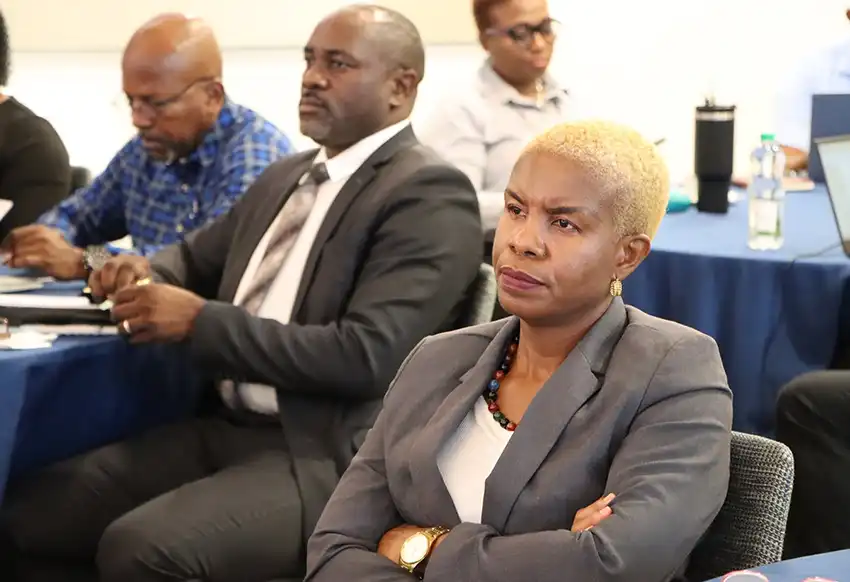
Addressing participants, Permanent Secretary in the Department of Labour, Sheila Imbert, said the workshop reaffirms the Department’s commitment to promoting safe and healthy workplaces. It follows Saint Lucia’s ratification of the International Labour Organization’s Promotional Framework for Occupational Safety and Health Convention, 2006 (No. 187), on June 5, 2025. The Convention recognizes a safe and healthy working environment as a fundamental principle and right at work.
“Today, this workshop marks a significant step in this groundbreaking journey in the development of the national OSH policy, as this will be Saint Lucia’s very first. And so I encourage you to engage thoroughly, ask questions, critique to improve, with a view to developing a national occupational safety and health policy that is current, responsive, futuristic and addresses the realities of our sweet country Saint Lucia,” said Imbert.
Board member of the Saint Lucia Employers’ Federation, Jimmy Evelyn, welcomed the development of the policy and noted the critical role of both employers and employees operating within micro, medium and large organizations in the informal sector.
“We have to look to prevention. We have to look to enforcement. We have to look to surveillance. These are critical. As we deliberate today, the Employers’ Federation would support the proper and guided implementation of an occupational health and safety policy.”
Recommendations gathered during the workshop will help shape the final policy before it is submitted to the Cabinet of Ministers for consideration. Subject to approval, a national programme will then be developed as the action plan for implementing the policy.
President of the Trade Union Federation Julian Monrose also endorsed efforts to establish a National OSH Policy, underscoring the importance of occupational safety and health to worker well-being, productivity and national development.
“The reality is that if we are not clear on what we require in terms of health and safety in the workplace, then anything goes and that should not be. We cannot speak of productivity and not speak about health and safety in the workplace. We cannot speak of a nation of healthy people if our workplaces do not take seriously matters of health and safety,” said Monrose.
“So what we are doing here today, what government through the Ministry of Labour is spearheading, is not just in terms of benefits for the workplace, but it is of national importance because it will have national implications and that is why we welcome it. We are happy to see the diverse groups and representation here so that when this policy comes out, we would expect that everyone will take responsibility to ensure that it is well implemented.”
Monrose further emphasized that the policy should inform necessary reforms, including institutional modernization and adequate resourcing, to support effective implementation nationwide.
All parties have concluded that the new policies and legislation must be accompanied by corresponding operational and institutional updates.