


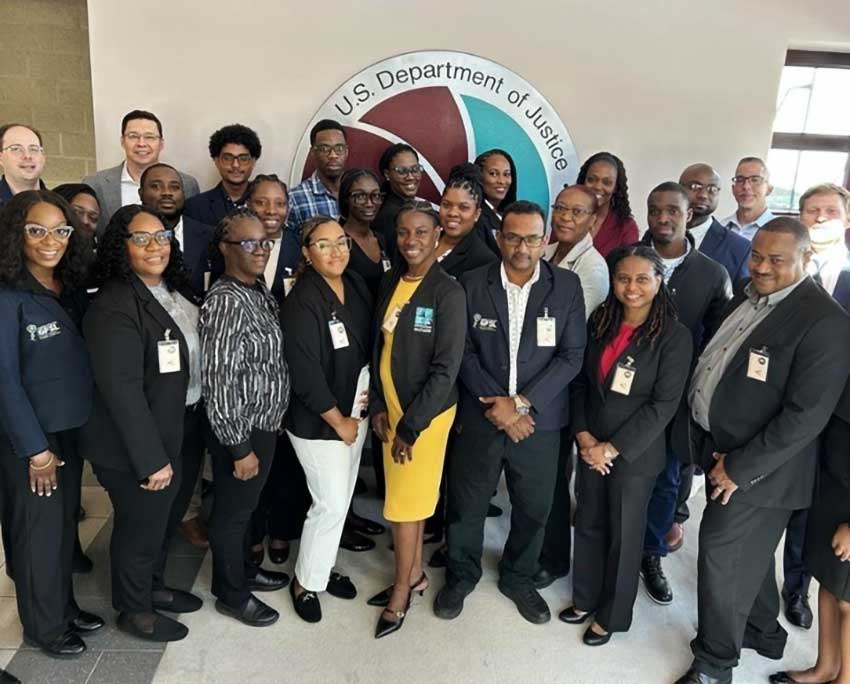
The U.S. Department of State’s Bureau of International Narcotics and Law Enforcement Affairs (INL) and the Drug Enforcement Administration (DEA) hosted forensic laboratory professionals from the Saint Lucia Forensic Science Laboratory (SLFSL) at the DEA’s Southeast Laboratory in Miami at a specialized training exchange to strengthen U.S.-Saint Lucia cooperation on synthetic drug detection and reporting through DEA’s Global Uniform Analysis and Reporting of Drug-Related Substances (GUARDS) program.
The SLFSL joined forensic lab directors, chemists, and quality assurance managers from the Guyana Forensic Science Laboratory, Jamaica Institute of Forensic Science & Legal Medicine, and The Royal Bahamas Police Force Forensic Laboratory at the five-day technical exchange. The DEA training combined theoretical instruction with hands-on Gas Chromatography–Mass Spectrometry (GC-MS) laboratory practices. Participants also observed DEA laboratory personnel process a 200-kilogram bulk seizure of suspected cocaine, providing real-world context for the advanced techniques.
This initiative addresses a critical capability gap by rapidly strengthening regional synthetic narcotic and fentanyl detection, safe handling, evidence preservation, and reporting in Saint Lucia and across the Caribbean. The SLFSL’s participation in the DEA technical exchange was funded by INL under the Caribbean Basin Security Initiative, a U.S. security cooperation program with Saint Lucia and 12 other Caribbean countries to degrade and dismantle transnational criminal organizations, curb illicit narcotics.
The United States says it remains committed to collaborating with Saint Lucia and Caribbean nations to combat the evolving threat of synthetic drugs. This training represents a significant step forward in developing the regional forensic capabilities necessary to detect and interdict fentanyl and other synthetic narcotics that are killing Americans and threatening our hemisphere and deepen regional security cooperation.