


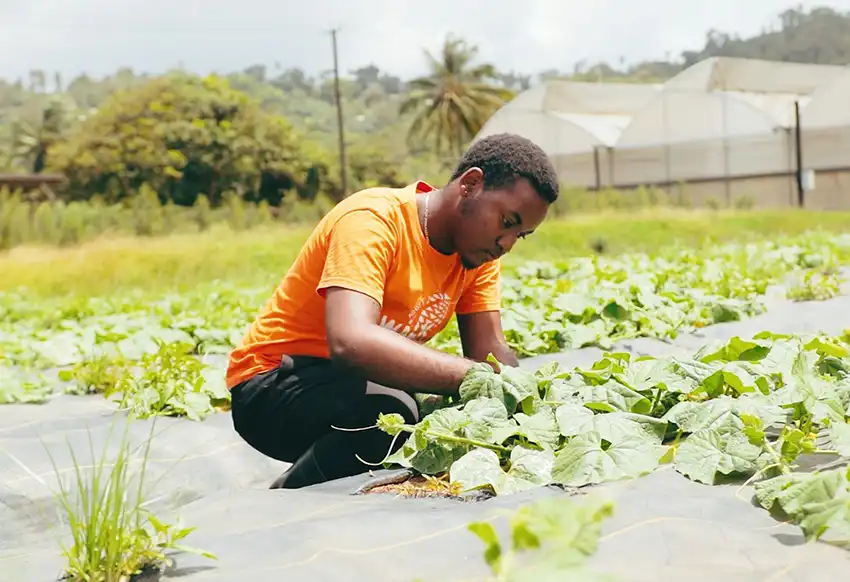
The Sir Arthur Lewis Community College (SALCC) Farm is using two agricultural research trials to explore crop varieties that could help Saint Lucian farmers improve productivity and better withstand climate and disease-related challenges.
The applied research projects, launched in 2026, combine scientific research with hands-on learning for SALCC students and use a Randomized Complete Block Design (RCBD) to assess the crops under local growing conditions.
The bell pepper trial, “Comparative Performance of a Climate-Resilient Bell Pepper Variety Versus Three Popularly Grown Varieties Under Protected Conditions at the Sir Arthur Lewis Community College Farm,” is sponsored by Colleges and Institutes Canada (CI Can) through the SAGE06 Project, and is being conducted in the college farm’s 100-foot greenhouse, with researchers assessing yield, fruit quality and the varieties’ ability to adapt to local environmental conditions.
The project also incorporates climate-smart production practices, including the use of 50 per cent shade cloth to reduce heat stress, plastic mulch for weed suppression and moisture conservation, drip irrigation and fertilization.
Biological products are being prioritised for pest and disease management, while compost tea, irrigation scheduling and uniform crop management practices are also incorporated into the research.
The peppers were produced in the farm’s nursery and transplanted on May 15, with harvesting beginning on July 15. Data are being collected from each variety throughout the harvesting period.
The second project is focusing on papaya and the challenge posed by Bunchy Top disease, which has been identified as a major constraint to papaya production in Saint Lucia.
Under the study, “Screening and Characterisation of Tolerance to Bunchy Top in Different Papaya (Carica papaya) Varieties,” six varieties are being evaluated to determine which demonstrate greater tolerance to the disease while maintaining desirable growth and production characteristics.
Researchers are monitoring plant growth, health, disease development and productivity under field conditions.
Ground preparation, installation of ground cover and irrigation lines, nursery production and transplanting were completed in July. The plants are now in their active vegetative growth phase, with regular data collection continuing.
The trials are also giving students practical experience in nursery production, crop establishment, experimental design, crop monitoring and scientific data collection.
SALCC said the research is expected to generate information that could help farmers identify crop varieties better suited to Saint Lucia’s environmental conditions while contributing to more productive and resilient agricultural systems.