


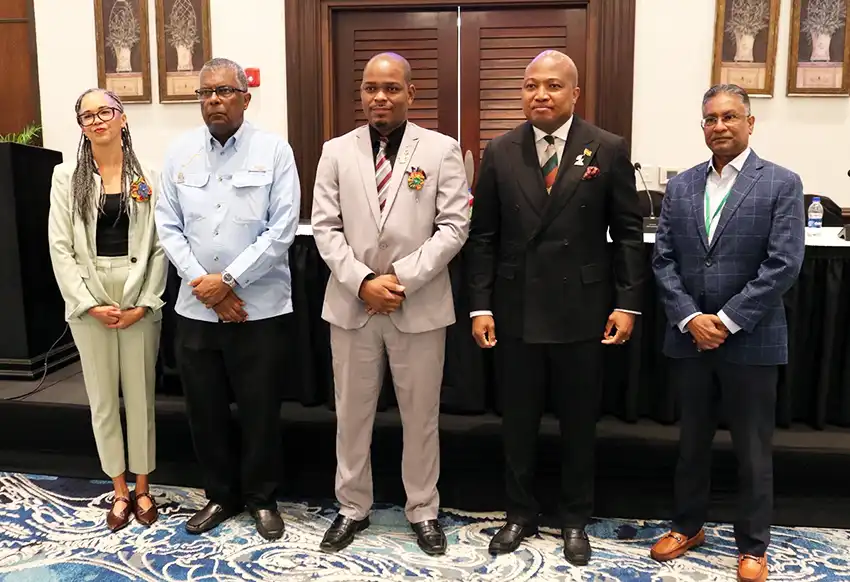
The Fossil Fuel Treaty Initiative convened a high-level ministerial briefing on the sidelines of the Commonwealth Heads of Government Meeting (CHOGM) in Antigua and Barbuda, bringing together foreign ministers and senior government representatives to discuss the role of an international treaty in supporting an equitable transition away from fossil fuels.
Discussions focused on the importance of international cooperation, the economic realities facing fossil fuel-producing countries and the need for financial and technical support to ensure that the global energy transition does not deepen existing inequalities.
The briefing heard remarks from Ministers of The Bahamas, Ghana and Antigua and Barbuda, as well as from former Central Bank Governor of Trinidad and Tobago, Jwala Rambarran. Also in attendance were the Foreign Ministers of St Vincent and the Grenadines, Lesotho and the CHOGM Heads of Delegation for the Seychelles and South Africa, among other Commonwealth countries.
Foreign Minister of Ghana, Honourable Samuel Ablakwa, Minister Ablakwa of Ghana said: “The proposed treaty deserved serious consideration, particularly in establishing credible arrangements to manage the economic, financial and social consequences of moving away from fossil fuels. A prospective treaty could offer meaningful support through a dedicated and accessible transition-financing mechanism for renewable and low-carbon projects,” Ablakwa said, calling for debt restructuring, concessional financing, technology transfer and technical assistance.”
He emphasised that countries must be allowed to pursue transition pathways that reflect their individual development needs, energy infrastructure and financial capacities. “A transition that leaves developing countries behind cannot be truly just,” he said.
Foreign Minister of The Bahamas, Honourable Frederick Mitchell, said: “In discussing the climate crisis, it is vital that we wholly accept the anthropogenic nature of climate change and its centrality to this phenomenon that presents an existential threat to SIDS. Anthropogenic, meaning that the climate issues we face today are directly or indirectly a result of human action, which also means we may choose to alter our course to counteract them.”
Minister for Health, Wellness, Environment and Civil Service Affairs of Antigua and Barbuda, Honourable Michael Joseph, underscored the importance of the initiative for small island developing states, who face increasingly severe climate impacts despite contributing relatively little to global emissions: “Antigua and Barbuda had been at the forefront of advocating for a Fossil Fuel Treaty since becoming the first Caribbean nation to join the initiative in 2023. For us, it’s about ensuring that the transition is just, practical, and it is not just done at one time but over a period to cushion the economic impacts on countries dependent on fossil fuels.”
He warned that continued reliance on fossil fuels threatens national development, livelihoods and the long-term survival of vulnerable countries, urging governments to participate in the global initiative.
The briefing provided an opportunity for ministers and representatives from across the Commonwealth to exchange perspectives on how a treaty could reconcile climate ambition with economic sovereignty, development priorities and social protection both as fossil fuel consumers and producers.
During her opening remarks, Gillian Cooper, Political Director of the Fossil Fuel Treaty Initiative, highlighted the limitations of consensus-based international negotiations: “Efforts to secure universal agreement can result in diluted ambition and influence from countries seeking to obstruct progress. A coalition of willing countries could instead establish a new standard for international cooperation and create political and reputational pressure for greater climate action. A treaty developed by first-mover countries could establish international benchmarks for national action, create a financial architecture to support the transition and connect existing financing mechanisms that currently operate in fragmented ways. The approach would serve countries ready to take meaningful action rather than wait for universal consensus.”
A growing bloc of 25+ countries is now engaged in discussions to develop a Treaty and are working towards a negotiating mandate. They are backed by a global network of more than 4,000 organizations, 200 subnational governments, hundreds of stakeholders across all sectors, Indigenous Peoples and a major civil society movement representing over a million individuals. The Fossil Fuel Treaty Initiative is a joint effort by governments and civil society working together to secure a global just transition and an international instrument to manage an equitable phase out of oil, gas and coal.