


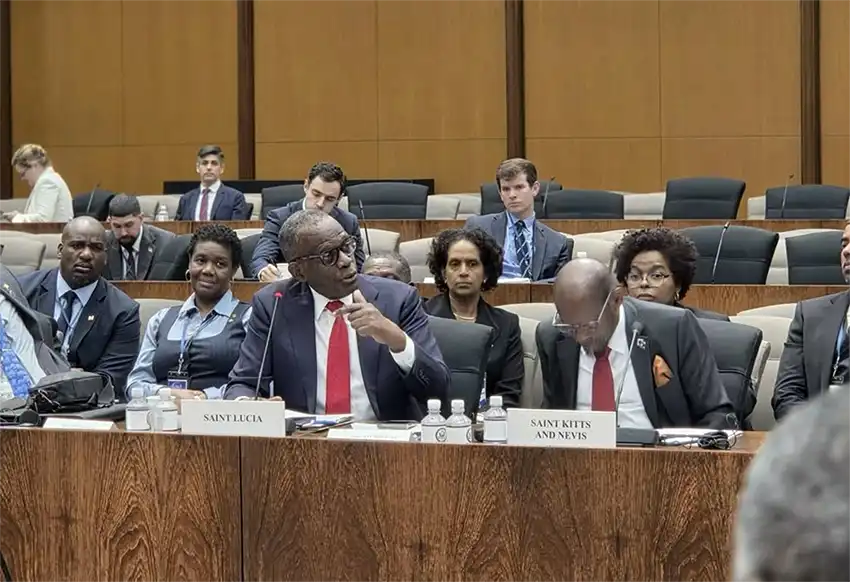
Following on the heels of the all-important meeting between Caribbean leaders and United States Secretary of State Marco Rubio in St. Kitts and Nevis in February, the parties agreed to meet again this week in Washington.
Prime Minister Philip J. Pierre, who is also the Chairman of CARICOM, headed the regional delegation dubbed the United States Caribbean Dialogue.
The dialogue which came after a request from Caribbean leaders for political level consultations at the initial meeting in February, also included Heads of Government of Saint Kitts and Nevis, Dominica and Haiti, alongside heads of delegation from other Caribbean countries.
For Prime Minister Pierre, families managing electricity bills, young people seeking work and communities affected by crime, formed the core of issues that needed to take center stage at the Washington consultation Thursday.
In his opening remarks, Prime Minister Pierre called for United States Caribbean cooperation to deliver more affordable electricity, investment and jobs, safer communities, and timely assistance after disasters.
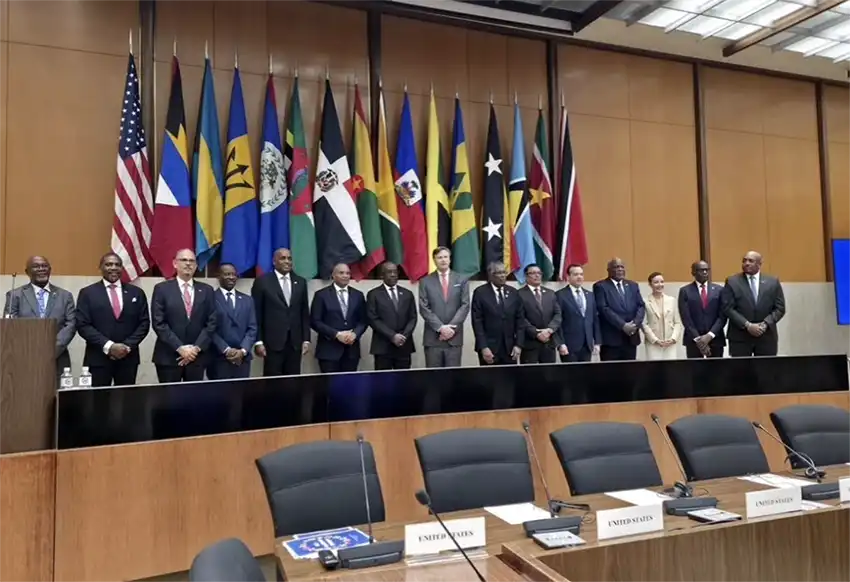
He urged partners to set clear priorities and follow through, so that people feel the benefits in their daily lives in real time.
United States Deputy Secretary of State Christopher Landau reaffirmed the importance of a partnership grounded in mutual respect, national sovereignty and the development priorities identified by Caribbean governments. He also outlined funding commitments for healthcare, security and digital connectivity, and announced plans for a United States–Caribbean Investment Dialogue in 2027.
Among the main issues brought up by the CARICOM chairman was the Haiti situation. In his opening remarks Pierre said “Haiti must remain central to our attention. We appreciate the United States’ role and welcome the extension of the United Nations mandate for the Gang Suppression Force. CARICOM continues its work through the Eminent Persons Group. Sustained international assistance and credible elections, with the widest possible participation, are essential to restoring confidence and supporting Haiti’s return to stability.”
US Assistant Secretary for Western Hemisphere Affairs, Juan Pablo Segura, reiterated the United States’ commitment to strengthening its engagement with the Caribbean, describing the dialogue as a tangible demonstration of Secretary of State Marco Rubio’s earlier pledge to deepen cooperation with the region.
He outlined three principal priorities guiding United States policy in the Western Hemisphere: promoting economic growth through investment, combating narcoterrorism and transnational security threats, and addressing illegal migration while strengthening national sovereignty.
Assistant Secretary Segura emphasized the importance of ensuring that Caribbean governments are fully informed of the financial and technical instruments available to support their development priorities. In this regard, he highlighted the Administration’s prioritization of foreign assistance to the Western Hemisphere, alongside evolving opportunities through the United States International Development Finance Corporation (DFC) and the Export Import Bank of the United States (EXIM).
Deputy Secretary of State Christopher Landau reaffirmed the United States’ commitment to revitalizing its engagement with the Caribbean, emphasizing the region’s historical, geographic, economic and cultural significance to the United States. He underscored the Trump Administration’s decision to restore the Western Hemisphere as a central priority of American foreign policy and stressed the importance of establishing enduring institutional partnerships that transcend individual administrations.
Deputy Secretary Landau emphasized that United States engagement with the Caribbean must be grounded in mutual respect, national sovereignty and genuine dialogue, with particular attention to the development priorities articulated by Caribbean governments. He identified private sector investment as the principal driver of sustainable economic growth, noting that traditional grant assistance, while useful, cannot substitute for lasting commercial partnerships. In this regard, he announced plans to convene a United States Caribbean Investment Dialogue in 2027, encouraging Caribbean governments to identify specific investment opportunities and prospective American corporate partners in advance.
He further announced significant financial commitments to strengthen regional cooperation in several priority areas:
- Healthcare: US$61.5 million to launch the Americas Strategic Partnership for Independent Regional Healthcare Excellence (ASPIRE), aimed at strengthening regional healthcare capacity and workforce development.
- Security: US$37 million in new programming under the Caribbean Basin Security Initiative (CBSI) to strengthen port security and protect critical digital infrastructure.
- Law Enforcement: An additional US$55.5 million to strengthen law enforcement capabilities and US$11 million in foreign military financing to enhance the capacity of regional security forces.
- Digital Infrastructure: US$175.8 million for secure regional connectivity through the Caribbean and Central America Undersea Cables Programme.
On regional security, Deputy Secretary Landau emphasized the importance of intensified cooperation to combat narcotics trafficking, illicit firearms flows, transnational organized crime and illegal fishing. He acknowledged the destabilizing impact of firearms trafficking from the United States into Haiti and expressed Washington’s willingness to strengthen law enforcement collaboration with Caribbean governments. He also proposed convening the next CBSI Security Ministerial in spring 2027.
Additionally, while in Washington, D.C., for the United States–Caribbean Dialogue, Prime Minister Philip J. Pierre attended a courtesy dinner with Taiwan’s Ambassador Alexander Tah-ray Yui and Mrs. Yui.
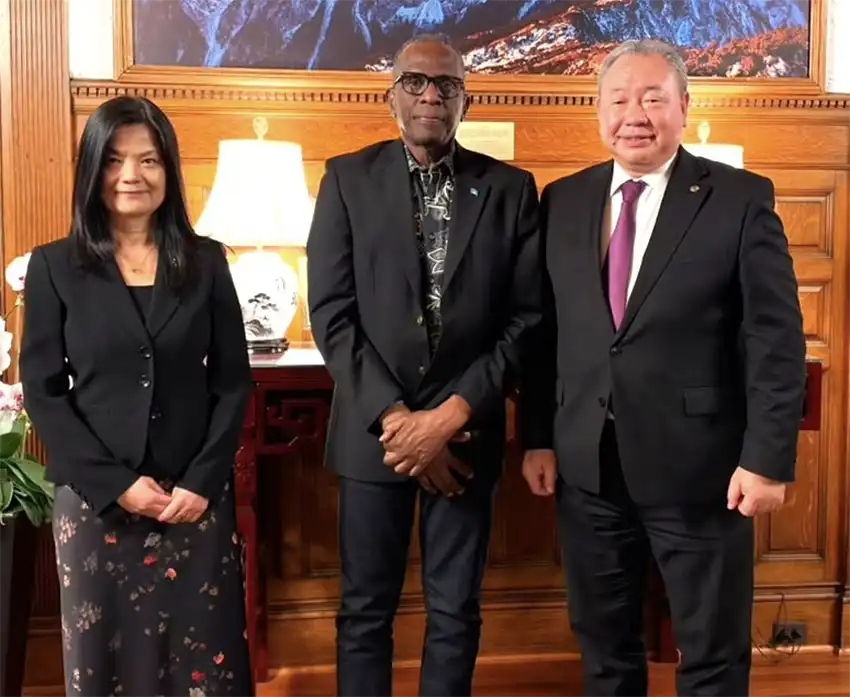
The event also included representatives of Taiwan’s office and members of the Saint Lucian delegation, including Minister for External Affairs Alva Baptiste.
The evenings discussions focused on geopolitical developments and strengthening relations between Saint Lucia and the Republic of China (Taiwan).