


Saint Lucia is embarking on a significant effort toward sustainable marine livelihoods and coastal restoration with the launch of a new partnership project.
This initiative is a collaboration between the Saint Lucia National Conservation Fund (SLUNCF) and the Ministry of Agriculture, Fisheries, and Food Security.
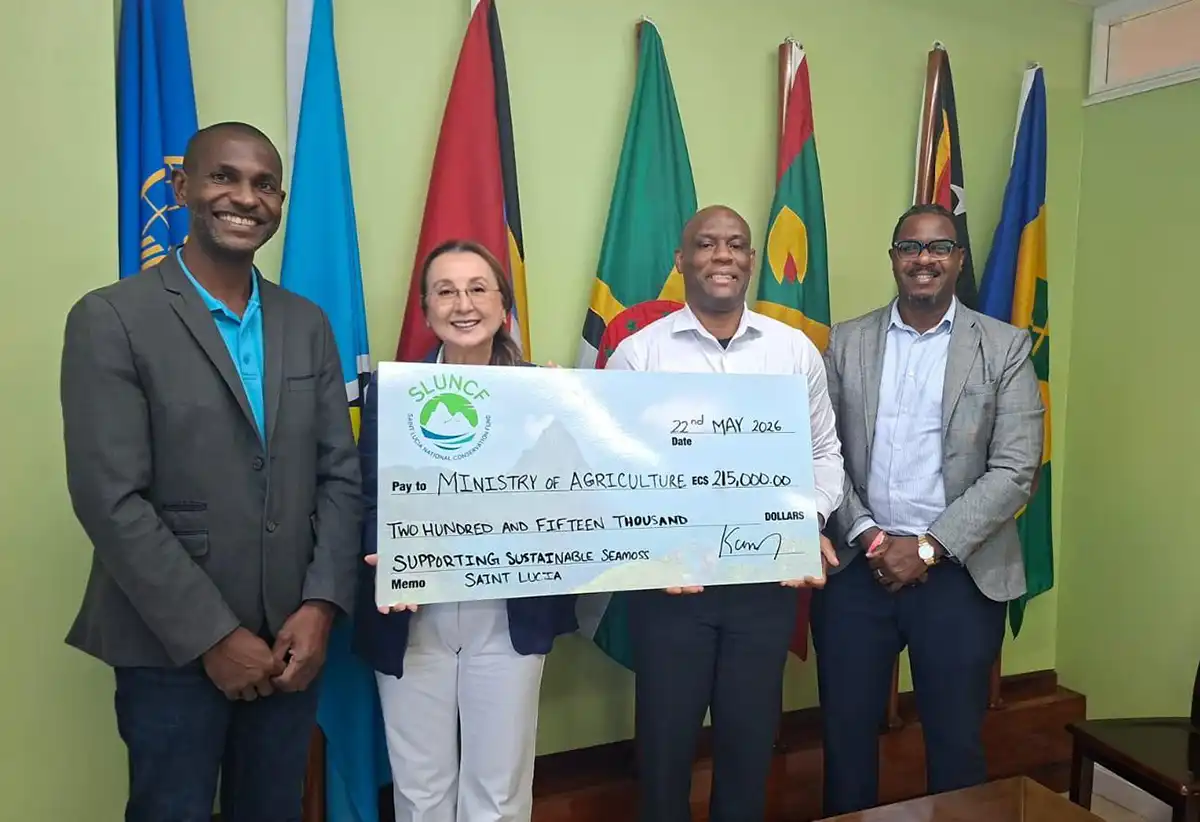
On Thursday, May 22, stakeholders gathered for a cheque handover and project launch ceremony for the Marine Debris Removal and Deployment of Sustainable Raft Systems in Savannes Bay, focusing on the seamoss component of the project.
During a formal signing ceremony held at the IICA Conference Room within the Ministry of Agriculture, stakeholders emphasized the critical benefits this project is expected to provide for the marine environment and the livelihoods of seamoss farmers in Savannes Bay, Vieux Fort.
Funded by the Agence Française de Développement (AFD) through the Caribbean Biodiversity Fund (CBF) as part of the Caribbean Regional Architecture for Biodiversity (CRAB) Project, this initiative represents a commitment of approximately USD $80,000 (EC $215,000) towards marine restoration, sustainable aquaculture, and community resilience.
Central to this initiative is a transformative vision of restoring degraded coastal areas while creating safer, more sustainable opportunities for seamoss farmers whose livelihoods rely on the sea. The project will facilitate the removal of marine debris from approximately 10 hectares of marine space and introduce 20 eco-friendly PVC raft systems designed to enhance seamoss farming practices and minimize future marine waste.
Bradley St. Ange, the Permanent Secretary in the Ministry of Agriculture, Fisheries, Food Security and Climate Change, described the initiative as a compelling example of how environmental protection can align with economic resilience.
“When we invest in restoring our marine environment, we are also investing in people, livelihoods, and food security,” he stated.
“This project embodies the kind of partnership and innovative approach needed to strengthen resilience within our coastal communities and fisheries sector,” he added.
The project aims to actively engage fishers and seamoss farmers from the Savannes Bay community through marine clean-up activities, sustainable raft deployment, and technical support in climate-resilient seamoss farming practices.
Deputy Chief Fisheries Officer Thomas Nelson highlighted the timely arrival of the project for the seamoss sector, noting that communities are adapting to environmentally related pressures impacting marine livelihoods. “Savannes Bay has tremendous potential for sustainable seamoss production, but healthy ecosystems are critical to that success,” he remarked. “By addressing marine debris and improving farming infrastructure, this initiative lays a solid foundation for the long-term sustainability and productivity of the sector.”
For the SLUNCF, the project signifies a broader commitment to initiatives that yield both environmental and community benefits.
Karolin Troubetzkoy, Chair of the SLUNCF Board, emphasized the importance of collaborative action in tackling pressing environmental challenges. “The strength of this initiative lies in the partnership behind it. When communities, government agencies, and conservation partners unite with a shared vision, we can create projects that not only restore ecosystems but also provide real opportunities for community prosperity,” she declared.
In addition to improving marine conditions in Savannes Bay, the project is anticipated to serve as a model for other coastal communities, potentially replicating initiatives in areas such as Laborie and Dennery.
Craig Henry, CEO of SLUNCF, expressed hope that the initiative will inspire ongoing investment in community-led environmental action throughout Saint Lucia. “The significance of projects like this extends far beyond the immediate activities,” he affirmed. “Cleaner coastal spaces, stronger livelihoods, and empowered communities all contribute to building a more resilient and sustainable future for Saint Lucia.”
As the ceremony concluded with the official cheque handover, stakeholders expressed optimism that the initiative will enhance both environmental stewardship and economic opportunities within Saint Lucia’s burgeoning seamoss industry.