


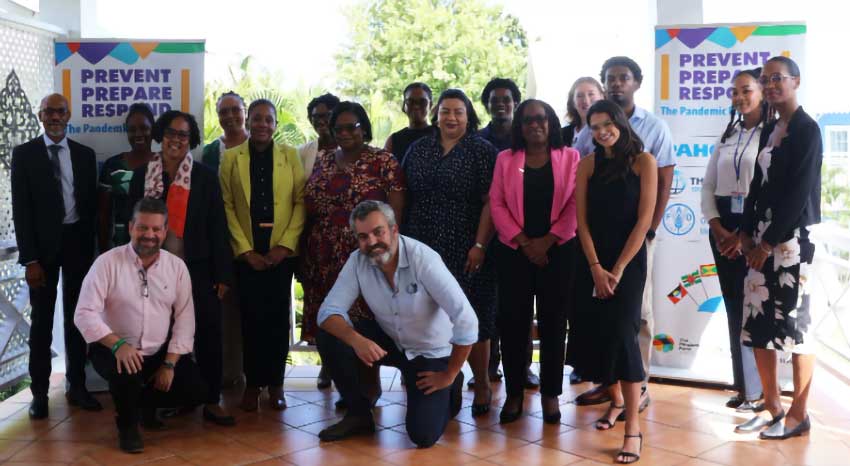
In an effort to strengthen preparedness, prevention, and response to emerging health threats, 72 officials from the Public Health, Agriculture, and Environment ministries, along with members of academic institutions and the private sector participated in workshops on the Prioritization of Zoonotic Diseases held in Grenada, Saint Vincent and the Grenadines, Saint Lucia, and Saint Kitts and Nevis.
The four workshops were delivered with technical support from the Food and Agriculture Organization of the United Nations (FAO), Pan American Health Organization (PAHO), through The Pan American Center for Foot-and-Mouth Disease and Veterinary Public Health (PANAFTOSA) and the PAHO Office in Barbados and the Eastern Caribbean Countries.
During the workshops, participants from the Ministries of Health and Agriculture reviewed 40 zoonotic diseases using the adapted PANAFTOSA prioritization methodology. The diseases were assessed against key criteria, including human transmissibility, animal-to-human transmission potential, severity and public health impact, economic impact, feasibility of surveillance, climate sensitivity, and impacts on vulnerable groups. This evidence-based process enabled each country to identify and prioritize the zoonotic diseases and health risks of greatest concern, providing a solid foundation for public policies at the human–animal–environment interface under the One Health approach.
The workshops also served to define the next steps for coordinated national action. Proposed priorities include strengthening routine multisectoral surveillance, harmonizing case definitions and standard operating procedures, improving information-sharing between sectors, engaging private veterinarians in national surveillance efforts, developing a national One Health emergency disease action plan, and planning long-term initiatives such as multisectoral simulation exercises and integrated surveillance systems. This process helped participating countries pinpoint high-priority diseases and reinforce their prevention, preparedness, surveillance, and control efforts. The resulting validated list of priority zoonotic diseases will improve cross-sector collaboration, streamline institutional coordination, and guide better public health decisions and resource use.
Dr. Frédérique DORLEANSAdvisor, Social and Environmental Determinants for Health EquityPAHO/WHO Representative for Barbados and the Eastern Caribbean Countries, underscored the importance of the workshops. She stated, “The collaborative and intersectoral workshops gathering Ministries of Health and Agriculture between the 10th and the 21st of November 2025 in the four Eastern Caribbean countries of Saint Vincent and the Grenadines, Saint Lucia, Grenada and Saint Kitts and Nevis, was a critical opportunity in advancing towards preparedness and strengthening capacities to respond to future emerging infectious health threats”. She added, this “Pandemic Fund project” jointly supported by FAO, PAHO/WHO and the World Bank, provided the opportunity to prioritizing the most relevant zoonotic diseases at the national level, hence, providing a common ground for future strategic activities targeting surveillance, effective prevention, and control as well as supporting resource allocation optimization, public health decision-making and intersectoral coordination under the One Health approach”.
Tania de Getrouwe Hoost, Livestock Development Officer and FAO’s Lead Technical Officer for the Project, highlighted the technical significance of the workshops. She stated,
“The zoonotic disease prioritization exercises provided an opportunity to apply a rigorous, evidence-based methodology that integrates epidemiological, environmental, and socioeconomic criteria to guide national decision-making. By systematically evaluating 40 zoonoses using the adapted PANAFTOSA framework, countries were able to generate validated, context-specific priority lists that directly inform the design of multisectoral surveillance systems, laboratory capacity-building, and targeted prevention and control strategies”. She added, “This process is a critical technical step toward operationalizing the One Health approach at national level, ensuring that human, animal, and environmental health sectors work from a shared risk assessment platform. FAO remains committed to supporting Member States in strengthening veterinary services and advancing coordinated preparedness capacities for emerging and re-emerging zoonotic threats.”
The four national workshops represent an important step toward enhancing health security, protecting livelihoods, and strengthening both national and regional resilience to emerging health threats across the Eastern Caribbean.
They form part of the project “Strengthening Prevention, Preparedness and Response to Health Emergencies in the Eastern Caribbean Countries (ECC),” funded by the Pandemic Fund. The project is led by the participating countries’ Ministries of Health and Agriculture, with PAHO/WHO, FAO, and the World Bank serving as implementing agencies.