


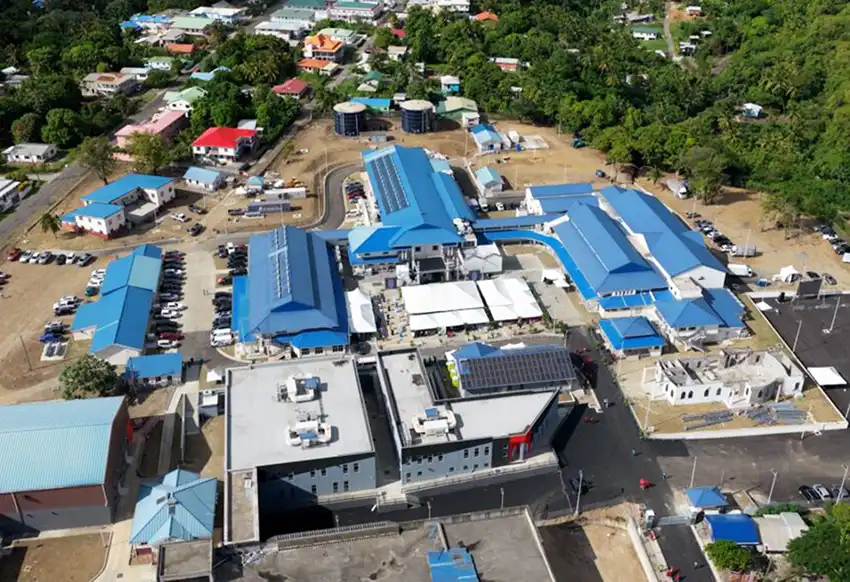
St Jude Hospital: Three Reports, $500 Million, and a Hospital Still Unfinished The reconstruction of St Jude Hospital has become one of the longest-running and most expensive public infrastructure projects in Saint Lucia’s history. Seventeen years after the devastating 2009 fire, successive governments have spent or committed more than $500 million on reconstruction, redesign and completion. Yet the fundamental objective remains unfulfilled: St Jude is still not fully operational as the general hospital the people of the south were promised. How did we get here? The answer cannot simply be reduced to which political party had the better plan. There were failures in the original reconstruction. There were decisions made to correct those failures. And in 2021, there was another major decision to change course. The proper question is therefore not simply who spent the money. It is: What did those responsible know when each decision was made? What did they do with that information? What did those decisions ultimately cost the country? And who should now be held accountable? Three reports provide critical markers along that journey: the Shanta King Exit Report, the FDL Technical Audit, and the 2021 St Jude Hospital Review Report. Read together, they tell the story of a project repeatedly assessed, repeatedly redesigned and repeatedly promised — but never brought to satisfactory completion.
The Shanta King Exit Report: The Starting Point.pdf
The Shanta King Exit Report is an important starting point because it records the state of the project at the end of her tenure as Project Manager and before the later technical decisions about how St Jude should be completed. King had headed the St Jude Project Management Unit from February 2010 until August 2016. The FDL audit itself confirms that period of responsibility.
St Jude FDL Interim Report.pdf
The significance of the Exit Report is that it provides an important record of what had been undertaken, what remained incomplete and what issues existed at the point when responsibility for the project was changing. That chronology matters. The problems surrounding St Jude did not suddenly emerge in 2016, and they certainly did not begin in 2021. By the time the first major independent technical audit was commissioned, Government was already confronting a project suffering from years of delay, escalating expenditure and uncertainty over what would be required to finish it. That is why the next document — the FDL Technical Audit — is so important.
The FDL Technical Audit: The Evidence That Changed the Course By late 2016, Government commissioned FDL Consult Inc. to undertake an independent Technical Audit of the St Jude Hospital Reconstruction Project. The purpose was explicit: Government wanted an informed basis upon which to decide how the hospital should be completed and operationalised.
St Jude FDL Interim Report.pdf
This was not simply an accounting exercise. FDL was required to examine the contracts, expenditure, designs and works already undertaken; assess their adequacy and quality; carry out technical inspections and testing; determine further reconstruction requirements; and establish the remaining funding required for completion and operation.
Its conclusions were devastating. Section 16, the Summary of Findings, opened by describing St Jude as a “mess of herculean proportions.” FDL said what had begun as reconstruction of the Surgical Wing had mutated into a redevelopment project that had “spun out of control.” The result was described as fragmented, poorly planned and poorly executed, with the project spiraling out of control in its form, intent, design and costs. St Jude FDL Interim Report.pdf By that stage, EC$118.1 million in works and supplies contracts had been awarded. Yet FDL estimated that the buildings averaged only about 50% completion, while external works were approximately 10% complete.
The supervising consultant’s original nine-month contract of EC$277,000 had meanwhile grown into combined consultancy contracts valued at approximately EC$11.5 million over six years.
The findings went much deeper. FDL reported that the EC$118.1 million in construction contracts had been awarded through direct awards and that there were no records of the selection criteria, negotiations or tenders.
It identified questionable subcontracting practices and concluded that mechanisms had been used which circumvented Government procurement rules. Of the large number of recorded subcontracts under the main contractors, FDL said only five agreements detailing their scope could be located.
Perhaps one of the most important findings concerned the absence of completed designs and meaningful cost control. FDL calculated that EC$76.56 million of the sums allocated under the main contracts had not been properly defined and, by extension, had not been designed at the time those contracts were awarded. Its conclusion was blunt: “Cost management did not exist.”
The problems were not merely financial. FDL identified shortcomings in the layout and functionality of buildings, corridors below recommended widths and planning decisions that could make future expansion disruptive and expensive.
More seriously, it found code violations in the majority of patient, staff and public areas, including deficiencies involving fire containment, egress and compartmentalisation, incorrect fire-door ratings and finishes that could compromise infection-control measures.
These findings are essential to understanding what happened next. The $100 Million Estimate — And What It Really Meant
FDL made a preliminary estimate that a further EC$100 million would be required to complete the existing facility. But that figure cannot fairly be presented as though Government had a guaranteed $100 million option to simply finish the hospital. That is not what FDL said. Immediately after giving the preliminary estimate, the report warned that “many unanswered questions” remained. More significantly, FDL concluded that a holistic design for St Jude did not exist and identified that as a central reason for the project’s problems. Its recommendation was therefore that construction should be further suspended, that a master plan should be developed, and that the existing facility should be aligned with that plan “if possible.” FDL further warned that a phasing plan would be required because of the cost of completion and reconfiguration.
That qualification changes the meaning of the $100 million estimate. The choice facing Government was not simply between spending another $100 million to finish the existing hospital or spending more money to construct a new one. The $100 million was preliminary. Serious questions remained about design, mechanical and electrical systems, plumbing, reconfiguration, safety, functionality and the actual extent of remedial works. It was against that background that a decision was made to construct a new hospital adjacent to the existing development, while continuing to utilise suitable components of the earlier project for support services such as administration, kitchen and laundry. Whether that decision was correct should be scrutinised. But it must be judged against the evidence that existed when the decision was made. Government had before it an independent technical audit describing the existing project as a “mess of herculean proportions,” identifying profound weaknesses in design, management, procurement and construction, and recommending that work remain suspended until a coherent master plan established the way forward.
The 2021 Review: The Decision to Reverse Course
Then came the change of government in 2021. A new Review Committee was appointed and the future of St Jude was reconsidered once again. Importantly, the Committee was asked to examine both possibilities: whether the new building, or part of it, could facilitate the transfer of the hospital from the George Odlum National Stadium, and whether elements of the earlier Phase 1 reconstruction could instead be used.
St. Judes Hospital—-SJHRP Review – Final Report – Oct 2021.pdf
The Committee made a consequential recommendation: “The proposed plan to complete the Ground Floor of the new Building should not be pursued.” Instead, it recommended completing the Phase 1 works and incorporating the newly constructed Physiotherapy and Dialysis buildings as the transfer facility.
Saint Lucia changed course again. The strategy of completing the new hospital was stopped. Government returned to the earlier reconstruction, while incorporating the newer Dialysis and Physiotherapy/Rehabilitation buildings. But there was another crucial part of the recommendation. It was supposed to be fast. The Committee treated completion as an emergency and proposed an approximately 18-month programme. Its timetable contemplated formulation of the completion plan during the first half of 2022, practical completion of Phase 1 by the end of 2022, the transfer of critical departments beginning in the first half of 2023, and the eventual decommissioning of hospital operations at the stadium.
That recommendation no longer has to be judged on promises or projections. It can now be judged against the result. Five Years Later: Judge the Decision by the Result Five years have passed since that decision. Approximately $350 million more, on the figures now being advanced, has been spent or committed on St Jude since the change of direction. Added to the huge expenditure that preceded it, the St Jude saga has now consumed more than half a billion dollars. And what is operational? The two major components of the newer development providing services are the Dialysis and Physiotherapy/Rehabilitation facilities. The full hospital is still not operating as the general hospital Saint Lucia was promised. That creates an unavoidable question. If returning to the earlier reconstruction was supposed to provide the faster route to getting St Jude out of the stadium, why has it taken another five years and hundreds of millions of dollars without delivering the promised result? The 2021 Committee itself made clear that its timetable rested upon assumptions concerning financing, documentation, approvals and the condition and readiness of the existing works.
Today we have something that Committee did not have in October 2021. We have five years of actual results. We know how long the strategy has taken. We know substantially more about what it has cost. And we can now compare those results with what was promised.
The $500 Million Accountability Question.
This is where the national conversation about St Jude must change. It is no longer sufficient for one government to blame another. If the original reconstruction consumed more than $118 million and produced the deficiencies documented by FDL, someone must answer for that. If the subsequent decision to construct a new hospital was wrong, those responsible for that decision must explain the evidence and reasoning upon which they acted. But accountability cannot conveniently stop in July 2021. If the new hospital was stopped in favour of returning to the earlier reconstruction because that was supposed to provide a quicker route to a functioning St Jude, and five years and approximately $350 million later the full hospital is still not operational, those responsible for that decision must also answer for it. Accountability cannot change according to which political party holds office. It must follow the decisions and the money wherever they lead. Saint Lucia therefore deserves an independent accounting of the entire St Jude project: every major contract, every variation, every consultant, every redesign, every Cabinet decision, every change in scope, every dollar spent and every decision that materially increased the cost or delayed completion. The purpose should not be to manufacture political guilt. It should be to establish responsibility.
Parliament Must Now Ask the Questions
Parliament’s responsibility is not simply to approve expenditure. It is to scrutinise it. Parliament should determine why an 18-month strategy became another five-year construction programme. It should establish what was discovered after Government returned to the earlier reconstruction that had not been adequately recognised, investigated or costed before the 2021 decision. It should determine how much of the additional expenditure was required to address the electrical, mechanical, plumbing, design, structural, fire-safety and other deficiencies associated with the earlier project. It should establish what it would actually have cost to complete the new hospital in 2021 and compare that figure with the money ultimately spent pursuing the alternative strategy. And Parliament should answer the question that can now be asked with five years of hindsight: Was abandoning the new hospital and returning to the original reconstruction ultimately more expensive, slower and less effective than completing the new hospital would have been? That question should not be settled by political assertion. It should be answered by the engineering evidence, Cabinet records, contracts, expenditure records and an independent examination of the decisions. Nor would such an inquiry absolve anyone responsible for the failures before 2016. The first $118 million must be accounted for. The failures documented by FDL must be accounted for. The decision to construct the new hospital must be accounted for. The decision to stop it in 2021 must be accounted for. And the hundreds of millions spent since must be accounted for. After 17 years, three major assessments, multiple construction strategies and more than half a billion dollars, the people of Saint Lucia deserve more than another promise and another completion date. They deserve accountability. Because the question is no longer simply: When will St Jude Hospital finally be completed? The question Parliament must now ask is much harder: How does a country spend more than $500 million on a hospital and still not have a fully functioning hospital — and who is responsible?
At the end of the day, we have spent and estimated $500 million and we still do not have a fully functioning hospital.