


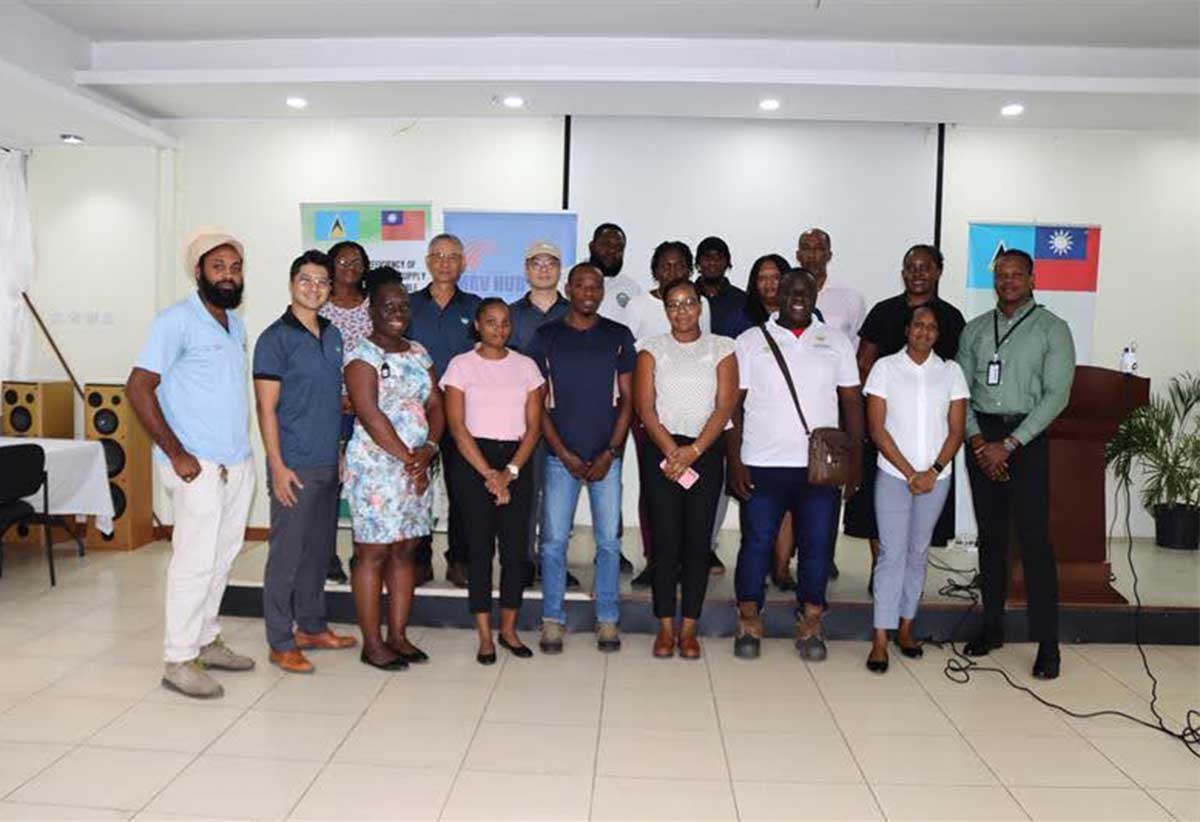
Key stakeholders, including farmers, extension officers, and policymakers, recently participated in a Data Analysis Workshop focused on the analysis of greenhouse gas (GHG) emissions data from crop production.
The workshop sought to familiarize participants with the analysis results, key findings, and underlying assumptions informing GHG emissions estimation. This workshop was part of the Climate Impact and Data Enhancement Project, aimed at enhancing GHG emissions analysis within Saint Lucia’s agricultural sector, thereby supporting national and international transparency efforts.
On January 27, the Ministry of Agriculture, Fisheries, Food Security, and Climate Change, in collaboration with the Caribbean Cooperative Measurement, Reporting & Verification Hub (CCMRVH) and the Taiwan Technical Mission (TTM) in Saint Lucia, convened the workshop at the Union Orchid Gardens conference room.
During the three-hour session, stakeholders reviewed the analyzed results, discussed data analysis and proposed actions, and fostered communication and coordination across the agricultural sector to improve GHG reporting and inform climate action.
Daniel Lee, Chief of Mission at the Taiwan Technical Mission (TTM) in Saint Lucia, highlighted the workshop as a significant achievement stemming from the Vegetable and Fruit Production and Marketing Enhancement Project (Phase II), known as the Seven Crops Project. He noted the project’s evolution from a focus on production techniques to a more integrated approach that encompasses climate resilience, digital data systems, and policy-relevant evidence.
“Our collaboration with the Caribbean Cooperative Measurement, Reporting, and Verification Hub further strengthens this effort,” Lee stated. “Together, we are building agricultural systems that are measurable, reportable, and verifiable—systems designed to meet national climate reporting needs while remaining practical and relevant for farmers and extension services. This partnership positions Saint Lucia as a key example in the Caribbean of how climate-smart agriculture and data governance can progress hand in hand.”
Lee emphasized that the workshop was not about presenting final results but rather an opportunity to collaboratively examine effective field practices, discuss strategies for simplifying and improving data collection, and ensure that approaches remain farmer-friendly and scalable. He expressed gratitude to the Ministry of Agriculture, the CCMRV Hub, and all partners for their collaboration, as well as to the extension officers and farmers whose feedback continues to guide the project’s direction.
Crispin d’Auvergne, Executive Director of the Caribbean Cooperative Measurement, Reporting & Verification Hub (CCMRVH), remarked on the underestimated value of agriculture in post-agrarian societies, which tend to lean more towards industrial and service-based economies.
“Despite its critical role in civilization’s development, agriculture is often taken for granted,” he explained. “It facilitated the shift from nomadic lifestyles to permanent settlements and the establishment of nations while driving technological innovation as people engaged with the elements to produce food and raw materials.”
In today’s warming world, d’Auvergne said , climate change poses increasing challenges, exacerbated by agricultural greenhouse gas emissions.
“To level the playing field, humanity must adapt, innovate, and implement climate-resilient, low-emission agricultural practices,” he stated. This workshop marks a crucial step towards enhancing climate-smart agriculture in Saint Lucia, promoting sustainability and resilience in the agricultural sector.