


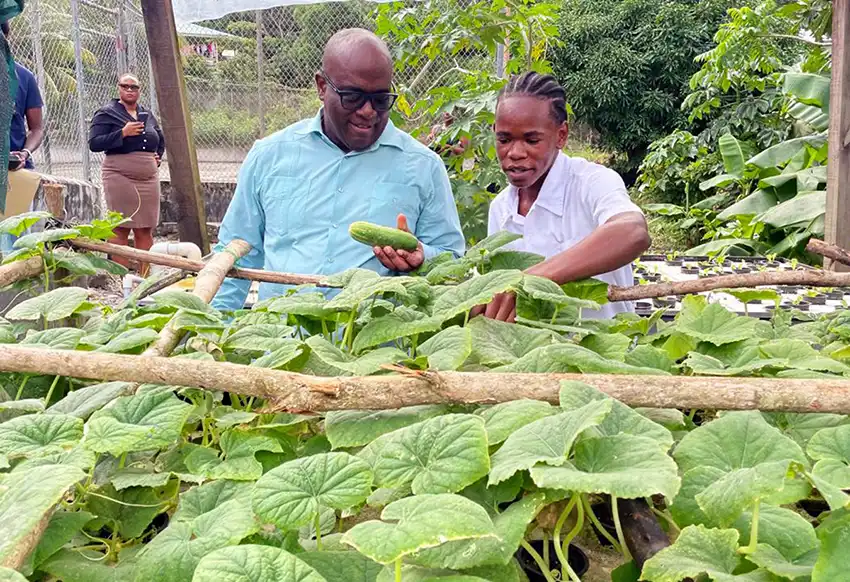
The ‘Green Revolution’ extends beyond current transformations in Saint Lucian agriculture; it aims to prepare the next generation to lead these efforts.
In line with this vision, the Babonneau Secondary School has undertaken an ambitious initiative to expand its Aquaponics Farm, recently adding three new hydroponics systems. This project, supported by strategic partnerships, is equipping students with practical agricultural skills while aligning with the Ministry’s aspirations for a Green Revolution in Saint Lucia.
The Aquaponics Programme, funded by the Saint Lucia National Conservation Fund (SLNCF) in partnership with Republic Bank (EC) Limited, showcases the school’s commitment to agricultural innovation.
Agricultural Engineer Joel Ramine from the Department of Agriculture noted that the initiative aligns with the Green Revolution agenda championed by Minister Jawahir, emphasizing its role in promoting innovation and youth development.
Ramine highlighted that this program represents Babonneau Secondary School’s contribution to the Ministry’s ‘Ten Pillars of the Green Revolution,’ which specifically targets youth engagement.
Parliamentary Representative for Babonneau, John Paul Estaphane, stressed the significance of combining modern agricultural technologies with traditional knowledge. He emphasized the need to transfer these innovations to local farmers, stating, “Let us encourage students to experiment, collect data, monitor plant growth, understand production costs, and explore opportunities for small-scale agricultural entrepreneurship.”
Estaphane further remarked, “Traditional agriculture is about building on existing practices with new knowledge, technology, and opportunities—not abandoning those traditions.”
The initiative provides students with essential insights into agriculture and promotes practical engagement in the field.
Melissa Adams, Head of the Science Department, emphasized the program’s importance in shaping students’ experiences and applying their knowledge in science, technology, and agriculture. She noted that the donation of the aquaponics systems, initially perceived as a “simple gift,” extends far beyond the classroom, offering students hands-on experience.
Since September, students have acquired valuable knowledge and skills related to aquaculture, crop production, sustainability, entrepreneurship, and environmental stewardship.
Importantly, a ministry official remarked that the program’s benefits go beyond mere cultivation; fish produced will be sold to generate funds, while crops will be converted into seasonings and other value-added products. This approach allows students to witness firsthand how sustainable agriculture can foster economic opportunities and benefit the school community.
Through its initiatives, Babonneau Secondary School is actively promoting an engaged food security sector, demonstrating that educating and empowering young people can enhance the understanding and value of agriculture.