


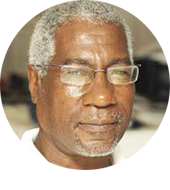
I came to know of Rickey Singh in the mid-1970s, following his writings when the Caribbean Community (CARICOM), not-yet a decade old, was still grappling with charting a new and independent 20th Century future.
The region was divided between big and small, independent and non-independent: Barbados, Guyana, Jamaica and Trinidad & Tobago were ‘The Big Four’ and the rest were ‘Lesser Antilles’ (also called ‘Windward’ and ‘Leeward’ islands) and the region was (as now) the world’s last remaining bastion of European colonies renamed French ‘Overseas Departments’ and Dutch ‘Antilles’, British and US ‘Virgin Islands’, Bermuda, Cayman Islands and Turks & Caicos Islands.
Rickey always had a problem with the region’s failure to unite and his entire career was dedicated to ensuring Caribbean people (and the world) truly understood the forever truth of the age-old saying: ‘The pen is mightier than the sword’.
He saw one region – and aptly named his weekly column ‘Our Caribbean’, which was simultaneously published, over decades, in the region’s major newspapers: Barbados’ ‘Nation’, Guyana’s ‘Stabroek News’, Jamaica’s ‘Gleaner’ and Trinidad & Tobago’s ‘Express’.
Rickey didn’t write to wash dirty laundry, instead weekly addressing the regional issues that define the wider Caribbean region – cultures, religions, values, history and politics that drive it – always underlying the need to build and tirelessly its youthful sovereignty.
He spent his lifetime encouraging the region’s journalists – young and old – to see ourselves as chroniclers of ages and agents of progressive changes.
We worked with other regional media stalwarts to establish national Media Workers Associations (instead of exclusive groupings of professional journalists) to highlight the equally important role of every other professional whose input is necessary to bring the words of journalists to the public’s eyes and ears.
The Caribbean Association of Media Workers (CAMWORK) was therefore established as a regional umbrella body for national associations.
Rickey had by then become known and appreciated across the region as a formidable writer and advocate for journalists’ eternal right to fight to write – and for all rights.
Indeed, Ricky fought for his absolute right to write from his first days as a reporter at the British-owned ‘Guiana Graphic’ in the early 1960s, where his coverage of local political events so-troubled the colonial hierarchy (and the local politicians who sought to replace them) that he was exiled to London – to cover court cases.
His native Guyana was always a rough ride, having to survive writing the truth under the then Forbes Burnham administration resulted in his early decision in the 1970s to relocate with his family to Trinidad & Tobago, from where the Caribbean Conference of Churches (CCC) established the ‘Caribbean Contact’ as a monthly journal to serve the entire region.
Rickey’s editorship of the ‘Contact’ didn’t go down well with the governments of at least two CARICOM nations from where it operated.
First, the discomfort of the then Eric Williams administration led to he and his family again relocating — this time to Barbados, under a more receptive Errol Barrow administration.
But regime change in Bridgetown would usher the JMG ‘Tom’ Adams administration, which eventually declared Rickey persona-non-grata, forcing him to have to leave Barbados every month — and return the next day – only to be humiliatingly granted the minimum number of ‘days’ any ‘visitor’ was allowed.
His battles with the Williams and Burnham administrations fortified Rickey’s determination not to be forced to compromise and he and his family finally settled in Barbados.
Rickey’s life forever revolved around his wife Dolly and their two sons and four daughters – Ramon and Raul, Allison, Debbie, Donna and Wendy.
His marriage to an Afro-Guyanese was a badge of honour Rickey always proudly wore, the glue that bound and bonded them simply a permanent reflection of their mutual human love for life, living and family.
It was too my unimaginable discomfort that Dolly closed her eyes for the last time a few years ago while Rickey was in Saint Lucia for medical attention – and it was my job to prevent him from getting that deadly news about her while away from home.
I had to collude with other conspirators and claim his phone was ‘misplaced’ (lest someone call to offer him ‘condolences’).
My wife and I signed a sympathy card from our family, which I gave him (with a heavy heart) and told him (holding back tears with a hypocrite smile) it was a greeting card ‘for Wendy…’
I attended Rickey’s 80th birthday celebration in Barbados and his 85th in Trinidad & Tobago — and on both occasions his regional and international colleagues wished him well in reluctant retirement.
In his last years, he simply missed the daily pleasurable professional grind of writing, typing and fingering keyboards — and up to his last days, would insist on having the daily newspapers delivered every morning – and simply complain: ‘There’s no news in the newspaper today…’
Rickey was my greatest inspiration, truly my most important mentor.
Covering CARICOM Summits was Rickey’s one ultimate annual assignment, distilling the usually-long Final Communiques in ways that readers could easily read understand how the issue affected them.
As fateful fate would have it, on Saturday (July 5) while sitting at Wendy’s Place (my favourite watering hole at Vigie) near the GFL Charles airport) when I got that call no-one ever wants – this time from a fellow veteran Caribbean colleague.
The Rickey I knew had ensured his last day on Planet Earth was CARICOM Day (July 4) and departed to The Great Beyond on July 5, Venezuela’s Independence Day.
Rickey it was who inspired me to make journalism my life’s job over the past 49 years and I named my twice-weekly regional column ‘Chronicles of a Chronic Caribbean Chronicler’ in tribute to our shared love for our common mission.
I never, ever thought that a day would come when I’d have to write about my mentor in past tense, but I should have…
I just did!