


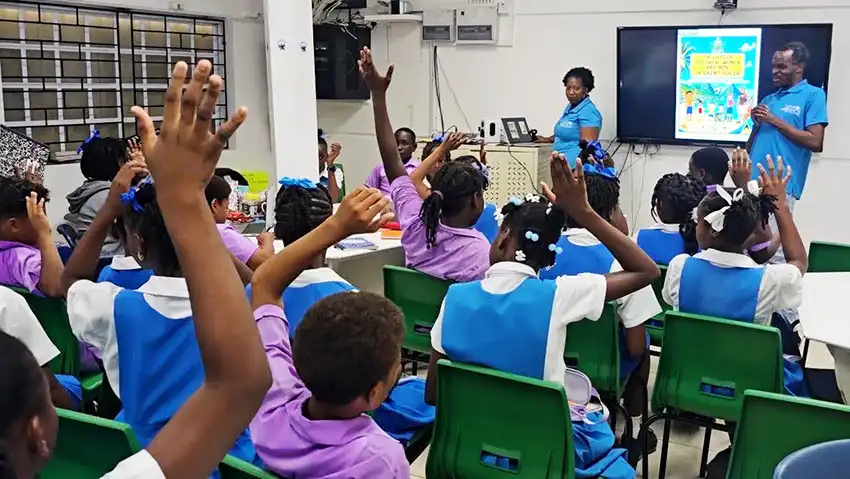
National statistics are moving beyond research reports and into classrooms as the 2025-2026 Multiple Indicator Cluster Survey (MICS) Educational Tour engages students across Saint Lucia in meaningful discussions on poverty, education, children’s rights and social inclusion.
The initiative, supported by UNICEF, the Department of Equity, Social Justice, Gender and Older Persons, and the Central Statistical Office (CSO), is transforming complex survey findings into child-friendly presentations, helping young people understand the realities affecting children, women and men.
Director of Social Transformation, Tanzia Toussaint, in the Department of Equity, Social Justice, Gender and Older Persons, highlighted the significance of introducing a male questionnaire in MICS 7 to strengthen national data collection and inform more inclusive government policies.
“For the first time in Saint Lucia’s implementation of the Multiple Indicator Cluster Survey (MICS), a male questionnaire has been introduced, underscoring the importance of inclusive participation in providing the government with comprehensive data to better inform policies, guide national development priorities and assess the circumstances affecting children, women and men,” stated Director, Tanzia Toussaint.
Meanwhile, at Vieux Fort Comprehensive Secondary School, Campus B, the findings prompted one student to reflect on the inequalities affecting children.
“Having the opportunity to attend school and receive an education is a privilege. I was surprised to learn that some children in Saint Lucia are unable to attend school or afford basic necessities such as food and clothing. This was particularly eye-opening for me, as these are things I often take for granted,” the student stated.
At Beanfield Secondary School, the discussion turned to equal opportunities for children living with disabilities. “It is important for all children, including those living with disabilities, to have equal opportunities to learn and participate. Every child has the right to an education, to be included and to develop to the best of their abilities. No child should be treated differently because of a disability,” one student said.
Vice Principal of Choiseul Secondary School, Hyjina Hippolyte, also raised concerns about boys’ educational participation. “This is quite alarming. Twenty-two per cent is a large number. This is of great concern because we need to know where these boys are at. We need to find ways and means to keep boys in school,” the Vice Principal Hippolyte noted.
MICS Programme facilitator, Leca James, welcomed the enthusiastic response to the school outreach initiative. “I find it worked out very, very well. I found that the students participated, that they were very welcoming, the principals, teachers, very welcoming and I found that overall this activity was a success,” James added.
At Choiseul Secondary School, one student emphasized the importance of listening to children’s perspectives. “I believe that adults or parents should listen to students or children because it builds communication, it builds trust, it builds a bond between them, and it shows that students’ perspective matters.”
The findings are expected to inform evidence-based policies and targeted interventions aimed at improving the well-being of children, women and men across the island.