


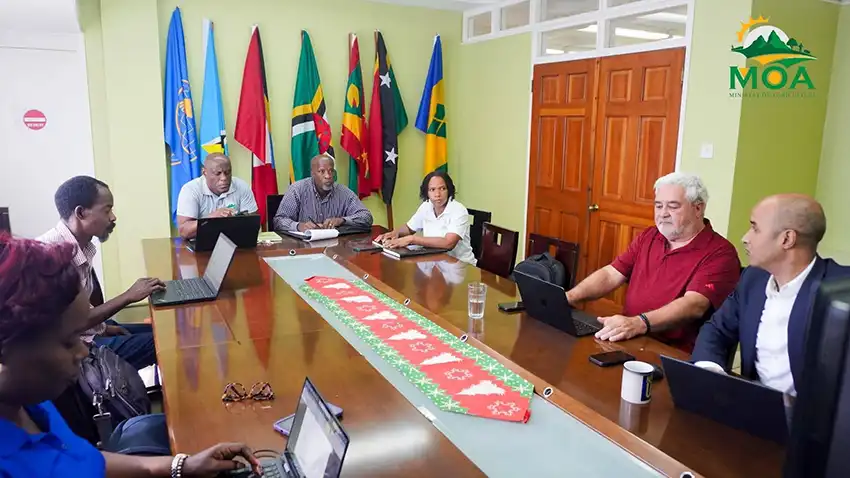
As part of this initiative, the Food and Agriculture Organization of the United Nations (FAO) recently completed a week-long mission engaging farmers, producer groups, and private-sector stakeholders to identify high-potential investment opportunities throughout Saint Lucia’s agricultural sector.
The country continues to push for agricultural transformation through high-level technical missions aimed at modernizing local systems and supporting the government’s 10-Pillar Green Revolution.
This program promotes key agricultural initiatives, including:
– IICA and CATIE Strategic Mission: Led by Minister Lisa Jawahir, the Department of Agriculture, Fisheries and Food Security hosted a technical mission with the Inter-American Institute for Cooperation on Agriculture (IICA) and the Tropical Agricultural Research and Higher Education Center (CATIE) to develop a road-map for modernization.
– Private Sector & Civil Society Engagement: Consultations brought together local partners, including Caribbean Grains Saint Lucia Ltd, E&E Agrochemicals, Helen’s Daughters, St. Lucia Agriculture Forum for Youth (SLAFY), and Massy Stores SLU, to enhance climate resilience and improve market linkages.
– FAO & Farmer Field Schools: The FAO is collaborating with Saint Lucia to update its Farmer Field School manual, building on previous work from 2006. This initiative is a part of the broader 2025–2030 Private Sector Engagement Strategy aimed at unlocking financing for small producers and cooperatives.
– Green Revolution Focus Areas: Current priorities include climate-smart agriculture, soil and water management, digital tools, protected/green agro-parks, and strategies to reduce the national food import bill. Saint Lucian farmers, agro-processors, and agricultural cooperatives can access various active government, development bank, and international grant and loan programs.
These initiatives provide capital, blended financing, and infrastructure support for crop diversification, climate resilience, and value-added production.
Government & Local Blended Financing
– MSME Loan-Grant Facility Extension: Administered by the Ministry of Commerce through the Small Enterprise Development Unit (SEDU), this blended facility offers low-interest loans combined with grant funding. Entrepreneurs may access between $10,000 and $25,000, while registered farmer and fisher cooperatives can receive up to $50,000 (split between 50% grant and 50% loan) for equipment upgrades, packaging, and food safety certifications.
– Saint Lucia Development Bank (SLDB) Agriculture Financing: The SLDB provides dedicated credit lines for purchasing farmland, rainwater harvesting systems, irrigation equipment, greenhouses, refrigerated transport, and specialized ventures like apiculture, hydroponics, and small ruminant farming.
– BELFUND Micro-Loans: Under the Ministry of Agriculture’s Micro Loans/Credit service, the James Belgrave Micro Enterprise Development Fund Inc. (BELFUND) offers micro-credit along with technical assistance for small-scale agricultural enterprises.
– Ministry of Agriculture Organizational Grants: Registered farmer groups and national agricultural organizations in the national database can apply directly to the Ministry of Agriculture for project-specific financial support by submitting formal proposals at least one month before planned activities.
International & Climate-Resilience Projects
– BRACCVAS Climate Resilience Project: Backed by a $9.8 million grant from the Adaptation Fund and implemented with the Caribbean Development Bank, this project will run through 2028, funding rainwater harvesting, soil conservation, solar-powered agro-parks, and vulnerability mapping across targeted farming communities.
– FISH-ADAPT Project (Aquaculture & Sea Moss): Launched by the FAO and the Government of Saint Lucia with $16.7 million in Green Climate Fund backing (running from 2025–2030), this initiative supports coastal farmers and fishers through storm-resilient sea moss rafts, aquaculture upgrades, circular economy initiatives, and landing site rehabilitation.
– 7 Crops Diversification Project (Phase 2): Managed by the Ministry of Agriculture, this initiative provides farmers with irrigation assessments, small-scale machinery, compost training, and agro-processing support for priority crops, including soursop, dragon fruit, pumpkin, squash, and carrots.
– GEF Small Grants Programme & Corporate Sustainability Funds: Grassroots agricultural groups can seek small-scale project grants through the Global Environment Facility (GEF) Small Grants Programme for eco-agriculture initiatives, as well as local private-sector sustainability funds. This comprehensive approach underscores Saint Lucia’s commitment to strengthening its agricultural sector and ensuring food security for its citizens.