



No one could seriously deny the honorific title of “Father of the nation” to Saint Lucia’s first and former Prime Minister John Compton (1925-2007). From his elected entry into Saint Lucian politics in 1954 to his death in office in 2007 as Prime Minister, he led the most consequential social changes in the island. He took Saint Lucia from a relatively poor sugar estate under British colonial rule to a modern prosperous Caribbean nation. That transition was not without many and huge challenges, periods of unpopularity. The Caribbean itself was moving from colonial dependency to independence, with a growing consciousness of new generations of their place in a racist, oppressive super-power world full of prejudices and many kinds of exploitation. But Compton, through social and educational improvements, led his people to a confidence in their abilities and capabilities. For over thirty years, his United Workers Party government was unbeatable at the polls. That he returned at 80 to win an election by a huge majority is testament to his charisma and leadership.
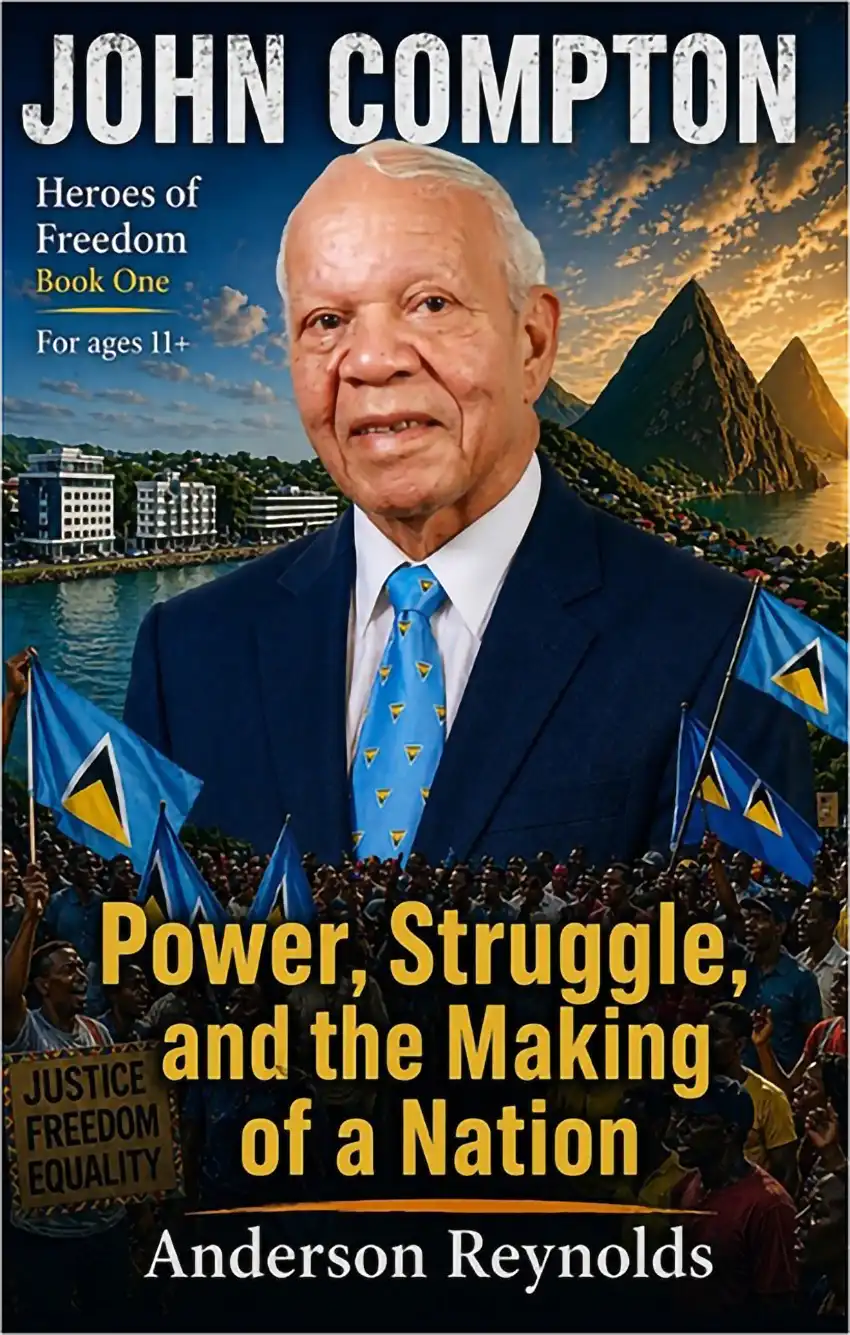
Saint Lucian writer Anderson Reynolds has recently published his latest publication titled “John Compton: Power, struggle and the making of a nation”. It seems to be part of a series “Heroes of freedom Book One – for ages 11+”. A good, comprehensive overall setting out of the political career and achievements of Sir John Compton. Good for younger readers, but also will be appreciated by older readers who will be reminded of how Compton and his governments led Saint Lucia out of crown colony government, its poverties, few educational, economic and other opportunities, its control by a few business and other plantation interests – into a modern, developed Caribbean independent nation. Compton was a colorful politician, modest in many ways, whose achievements are real and have contributed to present social and economic life. Dr. Reynolds’ new book is recommended, and a very useful, new historical record of the man recognised as the Father of the nation.
It is a sweeping biography, from Compton’s early life on Canouan, Saint Vincent and the Grenadines, his early education in Saint Lucia at St. Mary’s College, then his travels to Curacao to work. In 1948 he travels to London to study law at the London School of economics and is back in Saint Lucia by 1951.
With adult suffrage, Saint Lucia’s first general election was held in October 1951. The Saint Lucia Labour party led by George Charles won that election. In 1954, Compton ran as an independent for the Dennery/Micoud seat and won. In 1957, major sugar strikes with serious confrontations between sugar workers and factory owners brought Compton to the forefront as a popular defender of workers’ rights. In 1964, Compton forms and leads the new United Workers Party to victory in elections. The Compton era begins and for over forty years until his death in office as Prime Minister in 2007, he is the most influential leader of the country. The Labour Party did return to government for periods during those years, but Compton was the undisputed influential leader of his time.
Reynolds sets out in this book the major achievements of Compton and his governments. It is an impressive record of vision, political acumen, and a sense of how small Caribbean nations should develop in the mid-twentieth century. He took the economy from dependence on sugar to profitable bananas to tourism. He made major improvements in provision of educational opportunities, both in school construction and provision of scholarships. Electricity, water, social security, health, infrastructure especially in roads and major highways, housing, hotel and touristic facilities, foreign affairs all owed their developments to his vision and governmental leadership.
In 1979 he leads Saint Lucia into Independence and becomes the first Prime Minister. His long tenure was blessed with the international award of two Nobel Prizes – Sir Arthur Lewis for Economics in 1979 and Sir Derek Walcott for Literature in 1992. Men whom he knew well and had inspired him. Under Compton, the late sixties and seventies had seen a revival and renaissance of Saint Lucia’s arts and culture. He was an enthusiastic supporter of folk and other artists.
He retired as UWP leader in 1996, but returned in 2005 at 80 as leader of the party he had founded. Amazingly, he wins a landslide victory in 2006, but then dies in 2007 at 82.
No one, not even his political adversaries, would reserve their admiration for this master politician and respected Caribbean leader. He was involved in the formation of the regional bodies CARICOM and the OECS. His conservatism in politics was based on a realistic view of the place of small nations in the aggressive, more powerful world. He sought to find a way in between the “sharks” for the smaller “fish” of islands like Saint Lucia to survive.
Anderson Reynolds is a prolific Saint Lucian author. Among his several publications are other works on major Saint Lucian political figures, biographies of his father and mother and novels. This latest work is well written and a timely record of the significant achievements of Sir John Compton, Father of the nation, first Prime Minister. Recommended.