


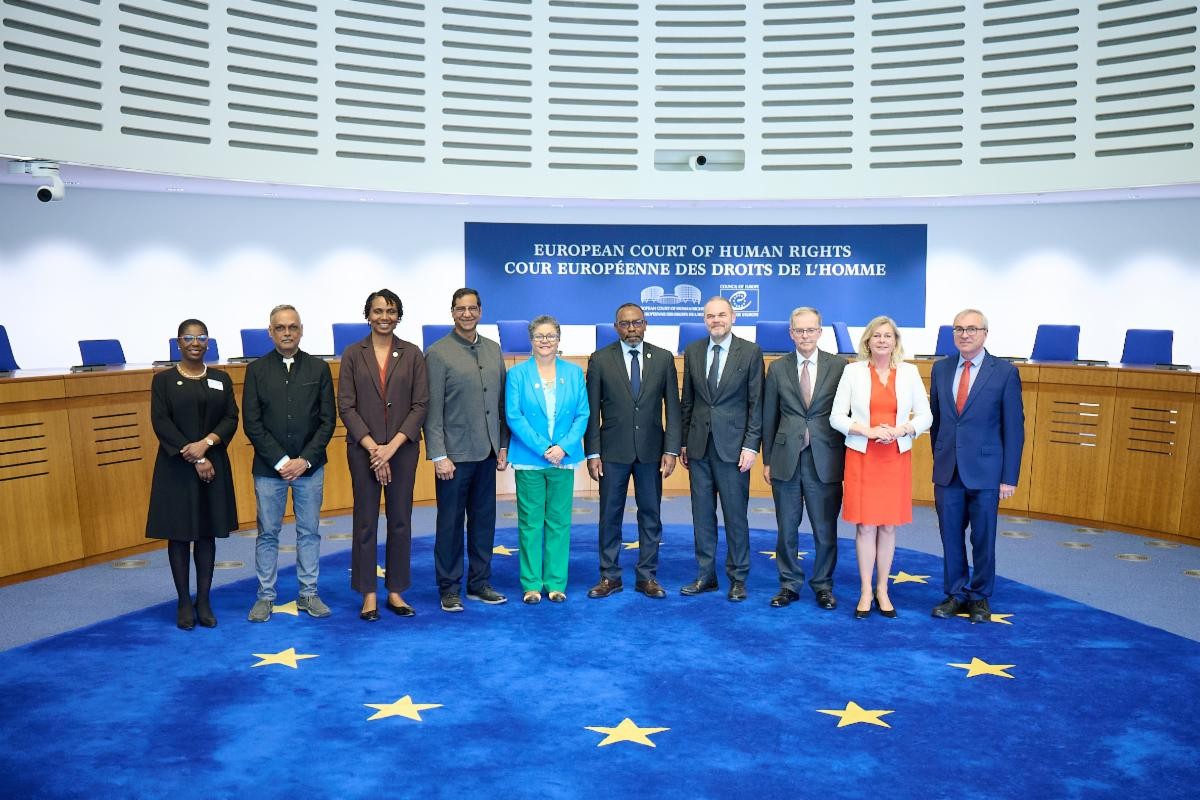
From 27 to 30 April 2026, a delegation from the Caribbean Court of Justice (CCJ) undertook an official knowledge exchange visit to key European judicial and regional institutions, including the Court of Justice of the European Union (CJEU) in Luxembourg and the European Court of Human Rights and the Council of Europe in Strasbourg, France. The visit facilitated high level judicial dialogue and the exchange of best practices aimed at strengthening court administration and jurisprudence.
During the visit, the CCJ delegation engaged in substantive exchanges on court governance, judicial administration, case management, and jurisprudential development, drawing on the experiences of peer supranational and regional institutions. The delegation was led by the Honourable Mr Justice Winston Anderson, President of the CCJ, and comprised members of the Court’s Bench and other senior officers of the Court.
In Luxembourg, the programme featured meaningful meetings with the Honourable Mr Justice Koen Lenaerts, President of the CJEU, and the Honourable Mr Justice Marc van der Woude, President of the General Court. The delegation also benefited from opportunities to observe the Court’s proceedings and administrative operations, including engagements with the Directorates of Communications, Library, and Information Technology, providing practical insights into institutional efficiency and innovation.
To further strengthen the strategic impact of the visit, the CCJ undertook high level engagements in Strasbourg, France, a global centre for judicial dialogue and human rights jurisprudence. The delegation paid courtesy calls on Vice President Arnfinn Bårdsen of the European Court of Human Rights and Mr Alain Berset, Secretary General of the Council of Europe. These engagements enabled a valuable exchange of perspectives on judicial independence, regional integration, and the role of supranational courts in promoting democracy, the rule of law, and fundamental rights, reinforcing the CCJ’s commitment to continued collaboration and institutional learning.
This visit was funded by a grant from the European Union under the 11th European Development Fund, underscoring the EU’s continued support for initiatives that strengthen the rule of law and judicial cooperation in the Caribbean.