


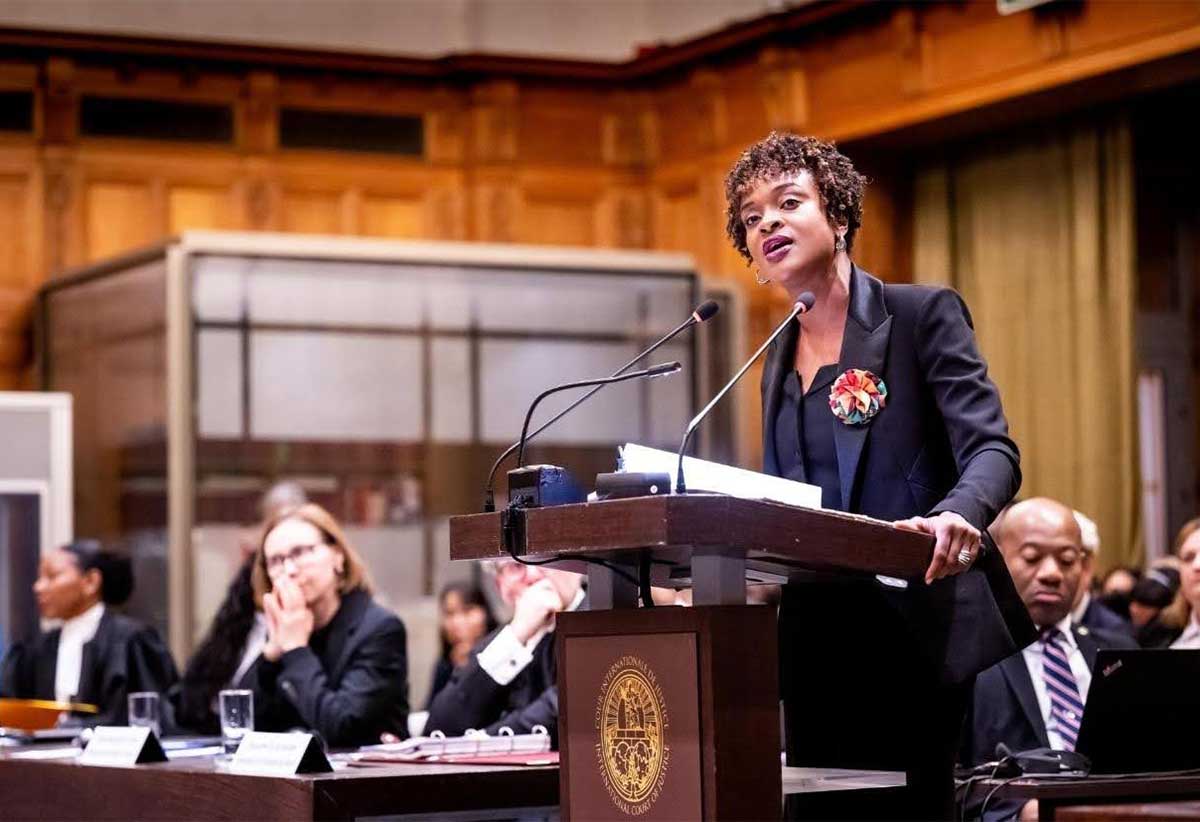
2. The Calling of Helen — Why Saint Lucia Joined
When I have been asked why I agreed to represent Saint Lucia, I can only offer a complex disjointed answer.
One strong feeling that compelled me from the very beginning was a growing sense of powerlessness; a sobering feeling that, with all we had done as a country, with our limited capabilities, to contribute to solving the problem of climate change, it still was not enough, and others with greater responsibility and capacity were not doing their parts. As we would set out clearly in our Written Statement, Saint Lucia has played an outsized role: we are parties to all of the international climate treaties – the United Nations Framework Convention on Climate Change (UNFCCC), the Kyoto Protocol, and Paris Agreement; we recently introduced our first Climate Change Bill in Parliament, submitted National Communications, and updated Nationally Determined Contributions (NDCs) under the Paris Agreement. Our then Minister James Fletcher even participated as a member of the ministerial team at COP21 where the Paris Agreement was adopted.
Under the maritime regime, Saint Lucia is a party to UN Convention on the Law of the Sea, and has signed the newest BBNJ Agreement. Saint Lucia is also a member of COSIS, the inter-governmental body created in 2021 to promote and develop rules of international law on climate change, and which requested an advisory opinion a Tribunal (ITLOS) on obligations under UNCLOS concerning the impacts of GHG emissions on the marine environment. (Its Opinion (May 2024) would later reinforce many of the arguments we made before the ICJ.)
Our musicians and artists have raised awareness of climate change impacts, through campaigns such as “1.5 to Stay Alive”; our poets and writers have produced iconic work highlighting the existential risks to SIDS.
Against this backdrop, when the Attorney General invited me to lead Saint Lucia’s participation in the Advisory proceedings, I accepted. Alongside Saint Lucian legal counsel—Mrs. Rochelle John-Charles (AG’s Chambers) and Ms. Kate Wilson (Ministry of Sustainable Development)—we formed a compact, purpose-built three-woman team. Our participation was not choreographed years in advance; it was a response to a last-minute regional stirring and a personal call to action by Dr. Justin Sobion, a Trinidadian by birth and a former law classmate of mine, working in the Pacific, who had reached out to me personally to help motivate broader Caribbean participation.
Once Saint Lucia had decided to join the proceedings, we met other like-minded CARICOM States at a regional “writeshop” held in Grenada in February 2024. There, supported by Vanuatu’s legal counsel—Prof. Margareta Wewerinke-Singh and Ms. Lee-Ann Sackett (to whom we are eternally grateful)—we understood the key role that the Pacific SIDS—and in particular Vanuatu—had played in championing the request to the UN General Assembly, which had then forwarded the request for an Advisory Opinion to the Court. At the writeshop, we also learned about our own regional realities and capabilities, and, guided by Caribbean scientists, climate advocates, international lawyers, and youth advocates, we framed an approach: blending science, law, and lived realities into submissions that were regionally rooted. We soon realized that, even if an Advisory Opinion by the Court was not like a normal dispute and would not be binding in its effect, it would clarify the law for all States, shaping climate negotiations, guiding domestic action, and possibly even preparing the ground for future litigation. That understanding began to open up possibilities for us on how we might use these proceedings to our advantage.
3. Our First Written Statement — Strategy, Science, and the Law
With a short period of time to draft – in fact less than a month – we knew we had to be strategic. With more than 100 States and entities were participating in the proceedings (a historic number for the ICJ), numerous legal instruments and norms that were potentially relevant to the first question, and decades of ICJ jurisprudence (I had not studied ICJ case law since leaving law school over 25 years ago), the terrain to cover was vast.
Our posture was simple: lead with science, make it personal, and argue the law holistically—with the realities of SIDS as the emphasis and through-line. It was our opportunity to “school” the world on SIDS, and Saint Lucia in particular: from our geographical positioning; to our geo-economic and political role in the global climate conversation; to our economic vulnerabilities; and finally, to the legal framing that underpins our claims for special treatment in various international legal frameworks.
1) Begin with Science then Make it Lived and Local
We anchored our submission in climate science. At the Grenada writeshop, Caribbean scientists serving on the Intergovernmental Panel on Climate Change (IPCC) – considered to be the “best available science” – had helped to distil the materials from recent IPCC reports that were most relevant to SIDS. We submitted these excerpts as an Annex to our Written Statement, paired with Saint Lucia’s own assessments — the First Biennial Update Report (September 2021), the National Adaptation Plan (2018–2028), and the 2006 and 2015 State of the Environment Reports.
Together, these reports demonstrated that the scientific community had agreed, by consensus that human activities, specifically anthropogenic GHGs, are causing harm to the climate system; and that present and future risks – sea level rise, extreme droughts, tropical cyclones, coral reef damage – pose significant challenges for the Caribbean threatening sustainable development. For Saint Lucia, we itemized the impacts by sector and people, highlighting in particular water resources, agriculture, fishers, tourism and coastal infrastructure, and at the human level, on women and vulnerable groups.
A theme we returned to repeatedly — because it is existential — was sea level rise. We spelled out how rising seas threaten Anse La Raye, Canaries, and Dennery, risking the loss of fishing utilities, community infrastructure, and cultural space. We framed the ocean as both memory and market — the place where our children learn to swim, and where our fishers earn their keep.
……to be continued