


Major stakeholders are engaged in a dynamic and inclusive initiative aimed at improving the livelihoods of fishers and fisherfolk in Saint Lucia and the wider region.
Project overview: A five-year, USD 16.7 million initiative (SAP053: Transforming climate resilience and sustainability in Saint Lucia’s fisheries communities), implemented by the Food and Agriculture Organization of the United Nations (FAO) with Green Climate Fund (GCF) funding and Government of Saint Lucia co-financing.
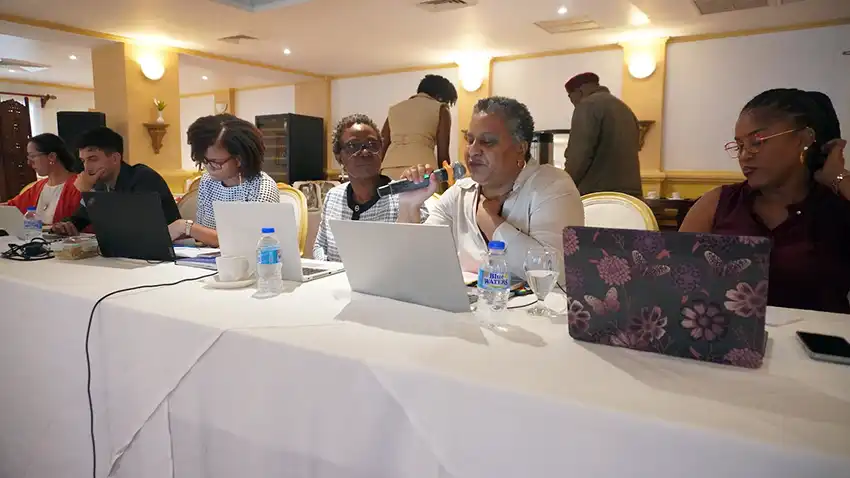
Recently, the 6th Project Steering Committee Meeting for FISH-ADAPT was held in Saint Lucia, focusing on transforming climate resilience and sustainability in the island’s fisheries communities. Implemented by the Food and Agriculture Organization (FAO) of the United Nations, the FISH-ADAPT Project is funded by the Green Climate Fund (GCF) and co-financed by the Government of Saint Lucia.
On Thursday, participants gathered at Stolen Times, Vigie, for updates on recent interventions, with some joining via video conference. Dr. Yvette Diei-Ouadi, Lead Technical Officer of the FISH-ADAPT Project, shared with the media that the annual meeting primarily focuses on planning, as the steering committee guides project implementation. She emphasized that the five-year funded project is currently in its crucial second year.
“In any five-year project, Years 2 and 3 are vital,” she stated. “We are entering a sensitive phase where active on-ground implementation is essential.”
Dr. Diei-Ouadi highlighted the project’s “value chain” component, addressing food systems, climate resilience, and procurement budgets, among other critical issues.
“Our goal is to permanently transform how fish is handled—processing, value addition, consumption, and marketing—to improve climate resilience upstream,” she explained. She noted that the program also encompasses upgrading landing sites to create safer, more profitable, and productive environments for all fishers on the island.
“This project extends beyond fisheries, embracing tourism, hospitality, finance, and community development, as well as aquaculture,” Dr. Diei-Ouadi remarked. “It is groundbreaking and ambitious.”
She emphasized FAO’s unique cooperative advantage, technical expertise, and experience in shaping policies and regulations to enable this transformation in Saint Lucia’s fisheries and aquaculture sectors.
Additionally, Dr. Diei-Ouadi stated, “The training component of the project will empower the community, allowing them to lead local activities.”
Recently, a stakeholder consultation was held with all nine cooperatives on the island to gather perspectives for this cooperative-led initiative, underscoring the importance of managing financial mechanisms at landing sites for effective data collection.
Saba Nordstrom, Project Coordinator and International Fisheries Specialist, provided an overview of the program and the numerous initiatives undertaken, as well as the agenda for the two-day workshop.
Simone Quaquarelli, Funding Liaison Officer for the FISH-ADAPT Project, noted that his role involves ensuring compliance with FAO and GCF regulations. He explained that the project is backed by a $50 million grant and co-financed by Saint Lucia’s Ministry of Finance and Ministry of Agriculture.
Highlighting the significance of GCF funding for Saint Lucia, he stated, “This project can greatly enhance the adaptation of the fishing sector in the country.”
Quaquarelli affirmed the project’s commitment to strengthening resilience in the fisheries sector, adding, “We aim to enhance farmers’ knowledge and capacities. This includes initiatives to help fishermen access finance and understand relevant laws.”
He concluded, “We are providing training and support to fishers to build their capacities, while collaborating with fisheries cooperatives to facilitate this transfer of knowledge.”
The project also focuses on improving landing sites—not just the facilities themselves, but also enhancing fishers’ management of these vital resources.
[R.A].