


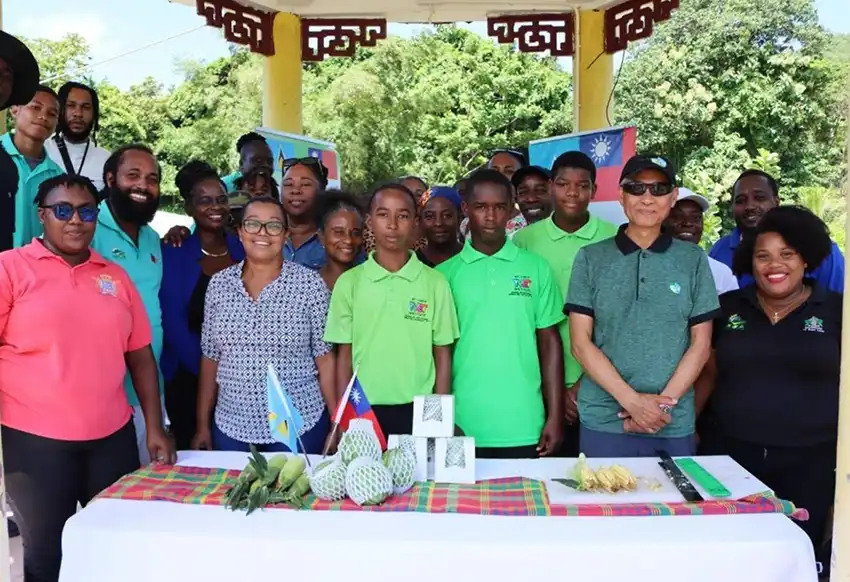
A recently-held workshop hosted by the Taiwan Technical Mission (TTM) in Saint Lucia that featured miniball watermelons and bi-color corn has generated a great deal of interest among participants.
The workshop was held at the TTM’s Demonstration Farm in Union, Castries, on Thursday, September 3, 2026, where seasoned farmers, kitchen gardeners and three students and teachers from the St. Lucia TVET Institute: School of Sustainable Agriculture and Culinary Arts, and learned firsthand about the many possibilities involved in cultivating and marketing the two cash crops.
The workshop participants first received a short briefing from the Taiwan Technical Mission team, including Mr. Johnson Yang, Senior Production Specialist at the Taiwan Technical Mission (TTM) in Saint Lucia, before touring the nearby plots to see firsthand how the miniball watermelons and bi-color sweet corn are cultivated. Afterward, they sampled some of the miniball watermelon and bi-color corn.
Miniball watermelons are small in size, with an average diameter of 6 to 7 centimeters and a length of 7 to 11 centimeters. They are round to oblong shape with blunt, curved ends, and the petite variety ranges from 550 to 650 grammes in weight and often fit into the palm of the hand. The rind is smooth, thin, taut, and firm, showcasing a pale green hue with dark green mottled striping. Some of the striping may be faint, and each watermelon has a unique pattern. Miniball watermelons are typically available in the summer. As cultivation increases, especially in greenhouses, the variety may appear throughout the year.
Bi-color corn has an elongated, cylindrical shape, and averages between 18 and 22 centimeters in length, and is encased in layers of dark to light green husks with thin, pale yellow fibers known as silks. As the outer layers are removed, the ear of corn is revealed, featuring both white and yellow, tightly packed kernels, wrapped around a fibrous cob. Each ear contains approximately 12 to 14 rows of smooth kernels that are crisp, aqueous, and tender. Bi-color corn is known for its high-sugar and low starch content, and at peak maturity, the kernels contain a sweet, sugary flavour.
Mr. Edward Wilson, Production Officer with the Taiwan Technical Mission (TTM) in Saint Lucia, noted that one of the main objectives of the workshop, and by extension, the Taiwan Technical Mission’s, is to support Ministry of Agriculture’s mandate of promoting food security on the island.
“At this workshop, this was specifically what we were trying to achieve,” he said. “Already, importation stands at an all-time high, specifically with apples, grapes and other prestige fruits. However, the miniball watermelons serve as a more than capable alternative which can be grown locally, yes, right here in Saint Lucia.”
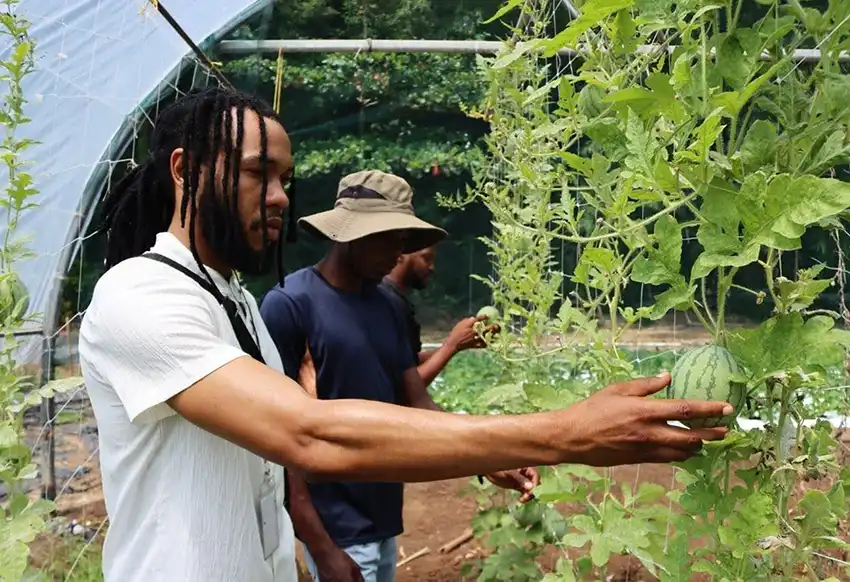
Mr. Wilson also noted that in order to reduce importation, all four pillars of food security need to be addressed, namely availability, accessibility, stability, and utilization (dietary needs), which perfectly places miniball watermelon in the conversation. For instance, children can include a miniball watermelon in their lunch bags for school as opposed to an imported apple. Similarly, small families can benefit tremendously without thinking of storing the remainder of the watermelon thus contributing to strengthening food security on island.
For the trials, Mr. Wilson said six beds were prepared for the miniball watermelons in the greenhouse, as well as in the open field. Different pruning methods were practiced and performance data recorded to determine which yielded optimal results as it relates to fruit quality and quantity. Presently, he said one can safely deduce that based on observations, the miniball watermelon variety fares much better under greenhouse production with a trellis system compared to open field.
Ms. Perlina Albert, Marketing Officer with the Taiwan Technical Mission (TTM) in Saint Lucia, conducted another aspect of the workshop, including the blanching of the bi-color corn, vacuum sealing, and labeling. She explained that the regular workshops are being hosted by the TTM with the focus being not only on planting and harvesting, but also on what farmers need to do in order to sell their produce.
She said the bi-color corn was included in the workshop after realizing that local corn is not often sold frozen, while imported corn is. The aim was to encourage farmers to grow corn locally and sell it frozen also.
“We really wanted to focus on the marketing part because quite often farmers grow their crops without knowing what to do with those crops,” Ms. Albert said. “So we show them how to freeze the corn, which adds value to it, as opposed to selling the corn wholesale. Also, by vacuum sealing the corn, it has a longer shelf life.”
Ms. Albert also encouraged farmers that before they do any type of packaging, they should consult with the purchaser to negotiate pricing and other details, and also with the Saint Lucia Bureau of Standards as it relates to complaint labeling.
Meanwhile, Ms. Lisa Hunte, Chief Nutritionist in the Ministry of Health, Wellness and Nutrition, described the miniball watermelon as crunchier and containing less sugar. She said watermelon is a hydrating fruit, meaning it has a high percentage of water, which is very healthy.
“It is also high in potassium, in minerals, and also has an anti-oxidant called lycopene, which helps to prevent cell damage and cancer,” she explained. “The miniball watermelon is low in sugar, so it’s actually good for people with diabetes.”
Also present at the workshop was Ms. Krystal Cox, a representative from Tropical Farms Supplies Ltd., the company that has been importing the Known-You seed brand since 2018. She said the brand is a very good one, and explained to the farmers the benefits of using that brand of seeds.
“It’s a brand that has a good balance between price and quality,” she stated. “We try to bring in seeds that work, not seeds that result in a high risk of plants dying or being susceptible to diseases. For that, I want to thank the team at the Taiwan Technical Mission that has been very helpful in conducting these demonstration plots.”