


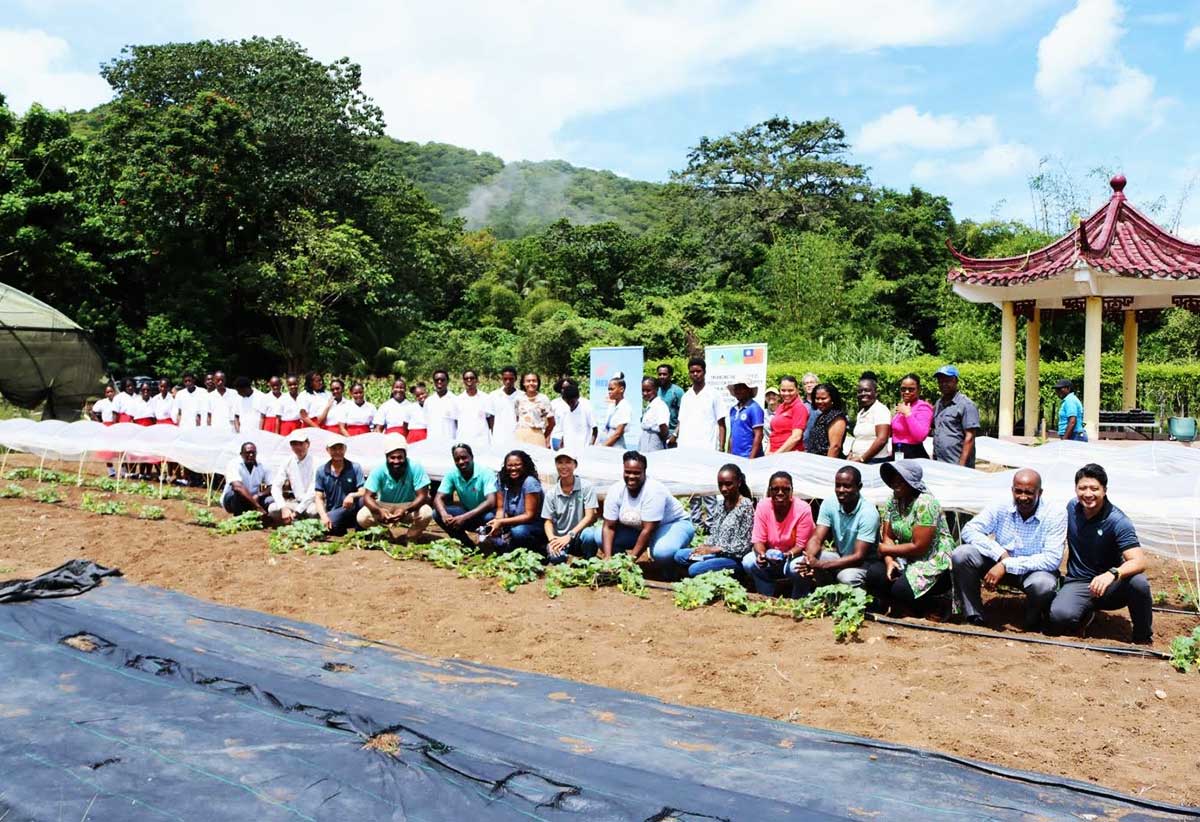
The Taiwan Technical Mission (TTM) in Saint Lucia recently hosted a field demonstration for extension officers from the Ministry of Agriculture and students from Castries Comprehensive Secondary School and Corinth Secondary School to showcase climate-smart agriculture.
The first demonstration session under the Climate Impact and Data Enhancement Project was held on Tuesday, October 7, 2025, at the Union Demonstration Farm.
The project is a collaboration that involves the Taiwan Technical Mission (TTM) in Saint Lucia, and the Caribbean Cooperative Measurement, Reporting and Verification Hub, with support from the Ministry of Agriculture, Fisheries, Food Security and Rural Development.
The project aims to strengthen the analysis of greenhouse gas (GHG) emissions within Saint Lucia’s agricultural sector, supporting national and international climate transparency commitments. The primary objectives of this field demonstration session are to:
- Showcase smart agriculture technology in particular the hoop greenhouses.
- Demonstrate the data collection process for computing GHG emissions from crop production.
According to Ms. Benise Joseph, Programme Officer of the Caribbean Cooperative MRV Hub, the focus is cantaloupe, one of the crops under the “Enhancement of the Efficiency of Productio-Distribution Supply Chain in Fruit and Vegetable Sector Project – Second Term”, commonly known as the “Seven Crops Project”.
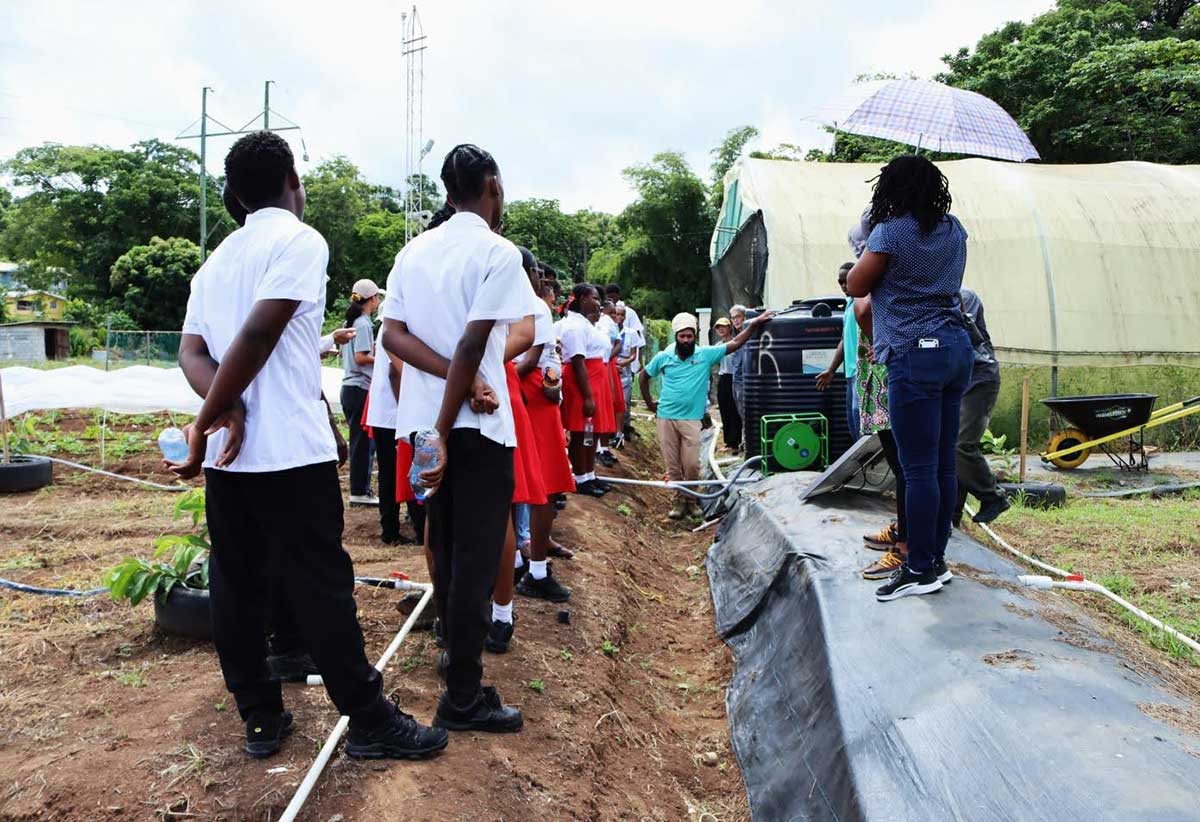
“We’re looking at the issues associated with data collection and how we can improve data collection in the agricultural sector,” she explained. “For example, the Taiwanese have introduced the hoop greenhouse. So we want to compare the produce grown under hoop greenhouses with the emissions and amount of water used compared to a conventional plot. We’re also comparing the differences in using solar pumps and electric pumps.”
Joseph said the field demonstration was held during the farm’s initial stage, with another planned closer to harvest time to compare the two stages. Following that second field demonstration, two workshops will be held: one where the data will be presented to participants and the other where the data will be presented to policymakers within the Ministry of Agriculture.
The Caribbean Cooperative MRV Hub focuses on climate change reporting, including estimating levels of greenhouse gas emissions and accounting for greenhouse gas emissions in the Caribbean. Joseph noted that while the Caribbean is not a major contributor to greenhouse gas emissions, the Region remains proactive in doing its part to reduce such emissions.
Mr. Daniel Lee, Chief of the Taiwan Technical Mission (TTM) in Saint Lucia, said the Taiwan Technical Mission remains committed to helping Saint Lucian farmers ensure food security while using climate-smart technology.
Mr. Crispin d’Auvergne, Director of the Caribbean Cooperative MRV Hub, stated emphatically that climate change is real and it affects food production: “When our food is affected, our way of life is affected. So if climate change is affecting us, we must now find ways to continue to grow nutritious food in sufficient quantities to sustain us and keep our way of life.”
He said the Climate Impact and Data Enhancement Project not only focusing on climate-smart agriculture, but also compares the greenhouse gas emissions, i.e. carbon dioxide and other gases that escape into the atmosphere and cause global warming, which results in climate change.
“The idea is to try to get this concept of smart-agriculture into the mainstream agricultural sector,” d’Auvergne said.
Mr. Edward Wilson, Production Officer with the Seven Crops Project, said the agricultural sector is a major contributor to greenhouse gas emissions, especially animal manure and improper composting, which produces methane.
Edward added that hoop greenhouses were introduced to bolster production levels, especially during heavy downpours: “During the rainy season, we realized that the production of honeydew and cantaloupe dropped significantly because these fruits do not fare well in rainy conditions. The hoop greenhouses are transportable, collapsible, and lightweight. With hoop greenhouses, you also use less pesticide, and the harvests are almost 100%.”