


4. Sharpening Our Arguments — The Written Comments (August 2024)
A few months after we had filed Saint Lucia’s Written Statement, the Court invited delegations to provide Written Comments on each other’s Written Statements. While the prospect of reading through thousands of pages of legal arguments and claims, in limited time, was daunting, we decided to engage. In the end, responding to the Written Comments proved a godsend: they forced us to examine others’ submissions and gave us a sense of where disagreements were coalescing, where arguments needed strengthening, and where new ones had to be made.
By now, we had developed an easy rapport with our OECS colleagues in SVG and Grenada, and other CARICOM colleagues. Working with them, and supported by Vanuatu’s counsel, we shared summaries and analyses of the broader field of submissions. These “cheat sheets” provided a bird’s-eye view of where the major powers were landing.
Unsurprisingly, a stark divide emerged clearly. Historical polluters – mainly developed countries – were pushing hard against any finding of legal responsibility, arguing that the climate treaties created only “soft” obligations and/or that attribution of blame for climate change among states was not scientifically possible or legally necessary. Some newly industrialized States resisted too, arguing that the principle of CBDR-RC meant that only historical polluters should be liable for any of the damage caused by climate change. Many developed countries also sought to avoid any legal consequences for breach, and rejected ARSIWA’s applicability. By contrast, SIDS’ factual and legal claims derived from our special circumstances were rarely contested — even though the logical consequences – acceptance of some sort of liability – were.
With the battle lines drawn, we decided to only engage on specific areas of contestation, resuling in Written Comments that were shorter, crisper, and aimed at reinforcing core points. We focused on five main lines of argument.
First, we reminded the Court of its role was to clarify obligations – not defer to politics – and that the ICJ’s interpretive authority mattered precisely because other regimes — UNFCCC, Paris, UNCLOS, human rights law — were each grappling with climate change.
Second, and drawing heavily on the framing and arguments advanced by Vanuatu, we challenged the claim that there was no “relevant conduct” that could be identified as wrongful, or that responsibility for climate change could not be attributed to the actions of individual States or groups of States.
Third, and by this time, in August 2024, ITLOS had delivered its Advisory Opinion in the COSIS case. That Tribunal, seized of similar issues, had confirmed that GHG emissions fall within UNCLOS obligations to prevent, reduce, and control marine pollution, that States owe due diligence, and that special consideration must be given to SIDS. We urged the ICJ to follow this reasoning and apply it more broadly.
Fourth, we pushed back hard against arguments that the climate treaties are lex specialis that displaced custom or human rights. Instead, we stressed systemic integration: climate treaties reinforce, not replace, general international law. We argued that human rights — to life, health, culture, and a healthy environment — remain relevant, as acknowledged in the Paris Agreement’s Preamble.
Fifth, we reinforced the principle of CBDR-RC, and the differentiated responsibilities of States. We linked this not only to mitigation but to finance, technology transfer, and capacity building — obligations repeatedly affirmed in UNFCCC and Paris texts.
On the question of the legal consequences, we supplemented our earlier reliance on ARSIWA with greater detail. We argued, like others in CARICOM, that full monetary reparation was owed for climate harms. This could include contributions to funds (Loss and Damage, Green Climate Fund), as well as obligations of technology transfer. We pointed to fossil fuel subsidies, estimated by the IMF at USD 7 trillion in 2022, as evidence that States had resources but chose to perpetuate harm.
We also contextualized remedies within lived realities. For instance, Grenada and Saint Vincent and the Grenadines pointed to Hurricane Beryl, which had just struck in the time between the Written Statement and Comments, as an example of rapid-onset destruction requiring immediate finance and adaptation support. We added that displacement and migration caused by climate change must be recognized as legal consequences.
Though our Written Comments were modest in length, they played a vital role. They showed solidarity with other CARICOM States and other SIDS, whose submissions we cited, integrated ITLOS’ fresh authority, and underlined that climate law is not a closed system but part of the larger corpus juris. They also made clear that remedies must be real: not charity, but justice.
PART 2
5. Showtime — Oral Pleadings (The Hague, December 2024)
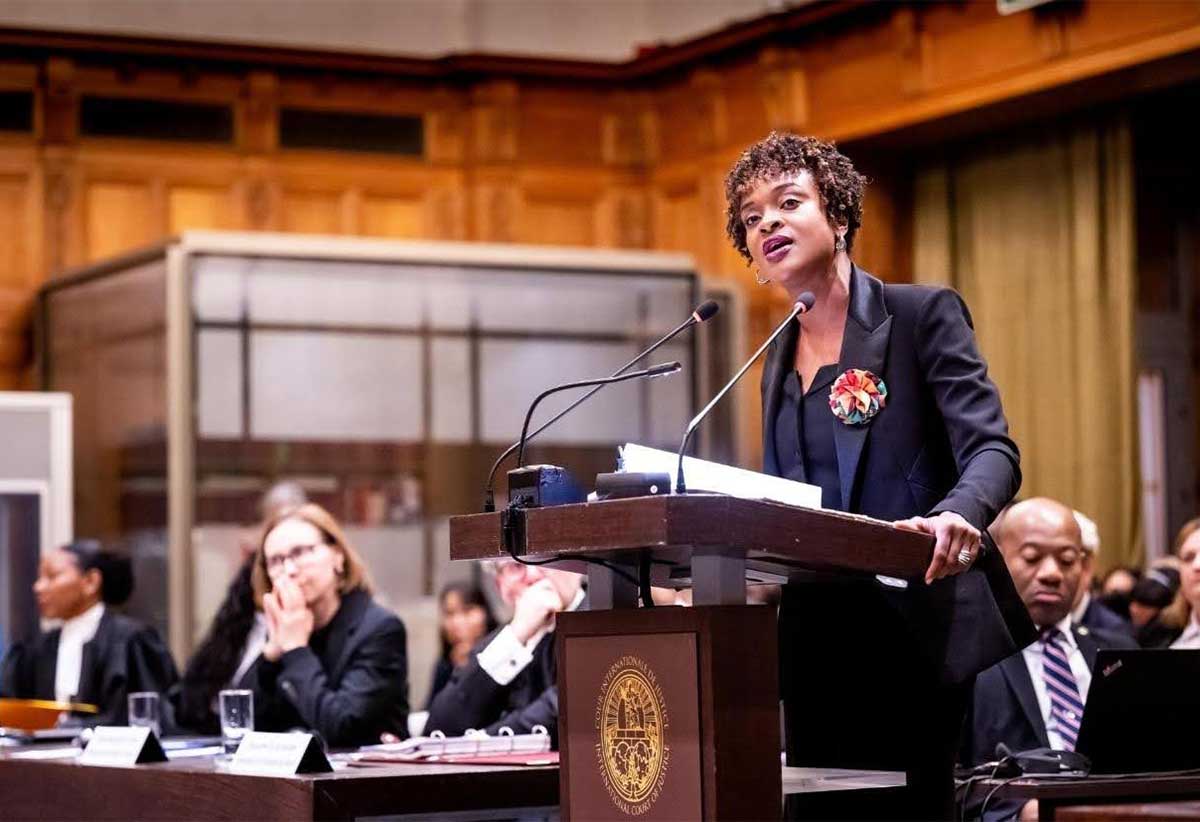
The public hearings for the Climate Change Advisory Opinion were held from 2–13 December 2024 in the Great Hall of Justice at the Peace Palace in The Hague. For those of us who work in international law, the Peace Palace stirs a deep sense of history and purpose; and the significance of this moment in my career was not lost on me.
Saint Lucia was one of nine CARICOM delegations to participate in the oral phase of the Advisory proceedings—Jamaica and Dominica having joined the proceedings only at this final stage. We were glad for the added numbers which would allow us to better execute the strategy we had agreed coming out of the November “advocacy” workshop in Barbados to prepare for this phase. The workshop, hosted at the Cave Hill Campus by UWI’s Faculty of Law (Prof. David Berry), myself (as Director of the SRC), and Dr. Justin Sobion, focused on a few core themes and legal arguments for each country to refine. At the same time, it encouraged us to draw on the lived experiences of the islands—especially recent disasters such as floods and hurricanes—to tell our story in different ways. We were also coached on posture and demeanor before the Court by experienced regional and international practitioners, and again supported by lawyers from Vanuatu. A memorable feature of the advocacy clinic was a session on the importance of “storytelling” in court—showing that what resonates is not only legal argument, but also narrative.
Armed with that guidance, our three-woman legal team set about preparing for the oral proceedings and devised a strategy shaped by both chance and choice. We worked diligently—meeting online and at the Ministry of Sustainable Development to draft, refine, and fine-tune our arguments, and to divide the presentations among us. Our goal was maximum impact—using imagery and storytelling while taking full advantage of our speaking slot: last on the day, immediately after the United Kingdom. This positioning allowed us not only to respond directly to the UK’s arguments, but also to close that day’s session with dramatic effect.
Inspired by the theme of storytelling, we chose a painting by Saint Lucian-based artist Jonathan Gladding, depicting a young girl submerged in water—whom we called Helen—to project on the courtroom screens. We also drew on Derek Walcott’s poetry, using his piece The Sea is History to connect the sea that holds our memories with the same sea that now threatens to submerge our country and our child, Helen, under the rising tides. The image became the quiet refrain of our case.