


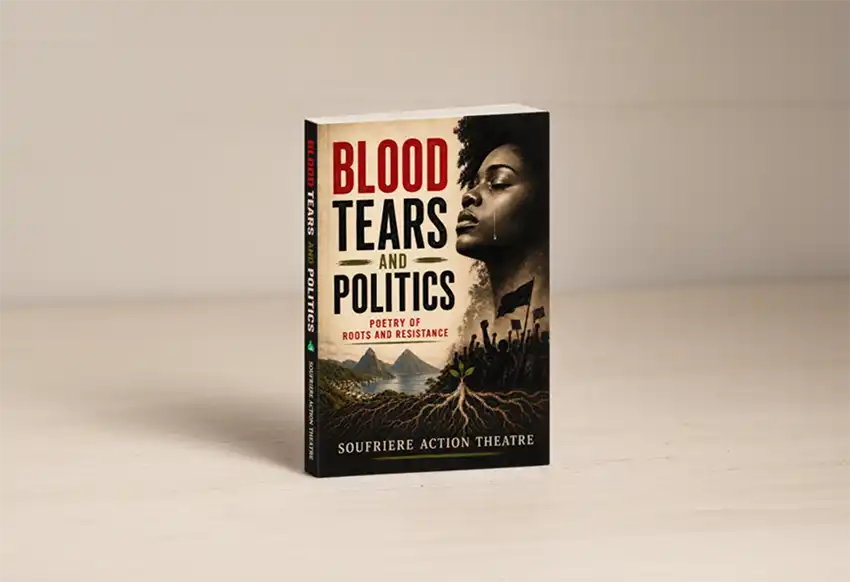
It is a rare opportunity that leads me to call a poetry collection vivacious. The subject matter, the lyrics, language, tone, and emotion conveyed throughout the volume entitled Blood, Tears and Politics: Poetry of Roots and Resistance create such an impression that to think anything less of it would be grossly underrating.
Set against the rich landscape of Soufriere—home to Saint Lucia’s iconic twin Pitons and a UNESCO World Heritage Site—these poems, the combined effort of members of the Soufriere Action Theater (SAT), speak openly about and to its people. Imbued with the authors’ impassioned sense of history, culture and place, this collection is a literary gem.
Additionally, since the book purports to give the reader a holistic appreciation of the various elements that occasioned the work, the background notes and testimonials are usefully complementary. Even the accompanying photographic images, I daresay, seek to, and succeed in, enhancing this broader understanding.
That said, a large core of the poems has universal appeal, as they address themes common to the human experience, as outlined in the front matter: “they speak of identity, injustice, memory, freedom, politics, love, resistance and survival.”
The collection is divided into five parts, and aptly subdivided under themes variously treated, suggesting what the authors want us to focus on. Taken as a whole, the poems are so craftily designed as to flow into a unifying whole, for the very reason that they were born out of the same breath of concern, love, commitment to community, humankind, and memory.
Nearly all the poems are marked by a sparsity of punctuation and in free verse styling (save for Innocent “Marbla” Aimable’s), which is the preferred form among the majority of contemporary poets. In any event, as mainly performance poetry, that’s quite understandable.
Appropriately, the opening composition, “An Lapwiye,” is a prayer of thanks and glorification for loved ones, for life, for livelihood.
Mesi pou bennediksyon lavi
Mesi pou li souf
Mesi pou lavi”
(Thanks for life’s blessings
Thanks for the breath of life
Thanks for life).
Followed immediately by a group composition, “Kimanye,” that denounces in the strongest language those who enslaved the African ancestors and avows a people’s right to choose its own religion, its own god—or gods:
Se Bouwo-a pwen nou dan Afwik…
Se Bouwo-a mete nou an eslavaj…
Se Bouwo-a di late pa bondye…
SAT ka di’w la ni plisye bondye…
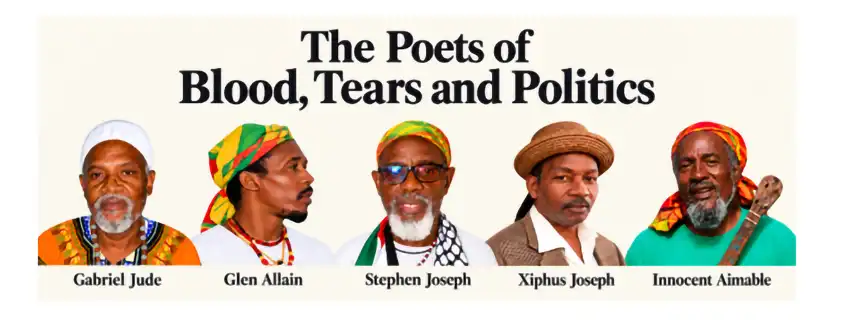
In one of the strongest pieces speaking to enslavement, resistance, freedom, identity, and survival all at once, Stephen Stevaco Joseph, one of the principal creative forces behind the project, writes in “Nou Vivan”:
If we no tell we story
Who go tell it for we…
And he goes on to lambaste the enslavers in uncompromising terms…
But in spite of all the brutal treatment endured over decades, nay, centuries, a people survives and is set to accomplish great things: “Nou vivan toujou ka bati nasyon.” A phrase that somehow has echoes of Maya Angelou’s “Still I Rise,” as it touches on the challenges
encountered in overcoming adversity.
Comparing notes, so to speak, one might be inclined to compare the title “Kimanye” with “Nou Vivan,” as they convey similar sentiments.
In section Part 2, I find the title “Inna Soul O” intriguing. Though clearly a tribute to a deceased colleague, I wonder if the author meant the onomatopoeic title as a double entendre for the word “solo”, a traditional folk-dance form similar to Kont and Debott.
Glen “Stylee” Allain’s “I Trinity” is yet another fine treat of conscious lyrics. His final lines, though evoking a laugh, couldn’t be more serious, vexatious, and damning of those nations that participated in the enslavement of Black Africans…
Each of the five contributors, through their lyrics and their decades-long involvement in the arts and service to community and nation, has meaningfully represented and upheld the objectives and spirit of SAT. Whether it be Gabriel “Parla” Jude’s “I Am From/My Origin”:
Soy de Santa Lucia
Del continente Africano
Mwen se jan St. Lisi
with echoes of Derek Walcott’s:
…moi c’est gens Ste. Lucie.
C’est la moi sorti;
is there that I born
in which both writers express pride in nationality.
Or Innocent “Marbla” Aimable’s rhyming schemes (though primarily “old school ” on the surface); Or Xyphus Ras Joseph’s 400 Years:
400 years they bring them down…
no mother no father
no culture no identity…
400 years
Young girls they turn whores…
400 years of living death
400 years is enough
The collection succeeds in remaining close to the themes adumbrated in the group’s profile.
However, if I may reveal my bias—which is not to devalue the others, as they all carry their own weight and loyalty to the expressed motto and mission of the group—Stephen Stevaco Joseph is easily my favorite, for his treatment of material: his verve, tone, and depth in his compositions. Even the Kwéyòl pieces are sparse in editorial requirements. Notwithstanding, it occurs to me that in his piece “Auction,” ‘lbs’ should be taken to mean pounds, as in the Sterling UK currency, recalling that English plantation owners were the principal players bidding at the auctioning of slaves.
In reading those poems, one can virtually imagine a setting in which the actors assemble on a stage, or in an open space, say a street in Soufriere, performing, drumming and chanting, and an audience in chorus, responding in sync. The collection is only a sampling of how art can unify a people through language, action, and symbolism that raise consciousness and motivate.
This collection ought to bring a high measure of pride and joy to Soufriere, to SAT, but especially to the authors. – Review (excerpt) by Modeste Downes
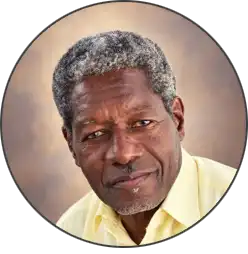 Modeste Downes is the author of Jungle Democracy on Trial: The Politics of COVID and three poetry collections: Phases, Theatre of the Mind, and A Lesson on Wings. An educator, trade unionist, songwriter, literary critic, and political and cultural activist, he has played a prominent role in Saint Lucia’s public and cultural life.