


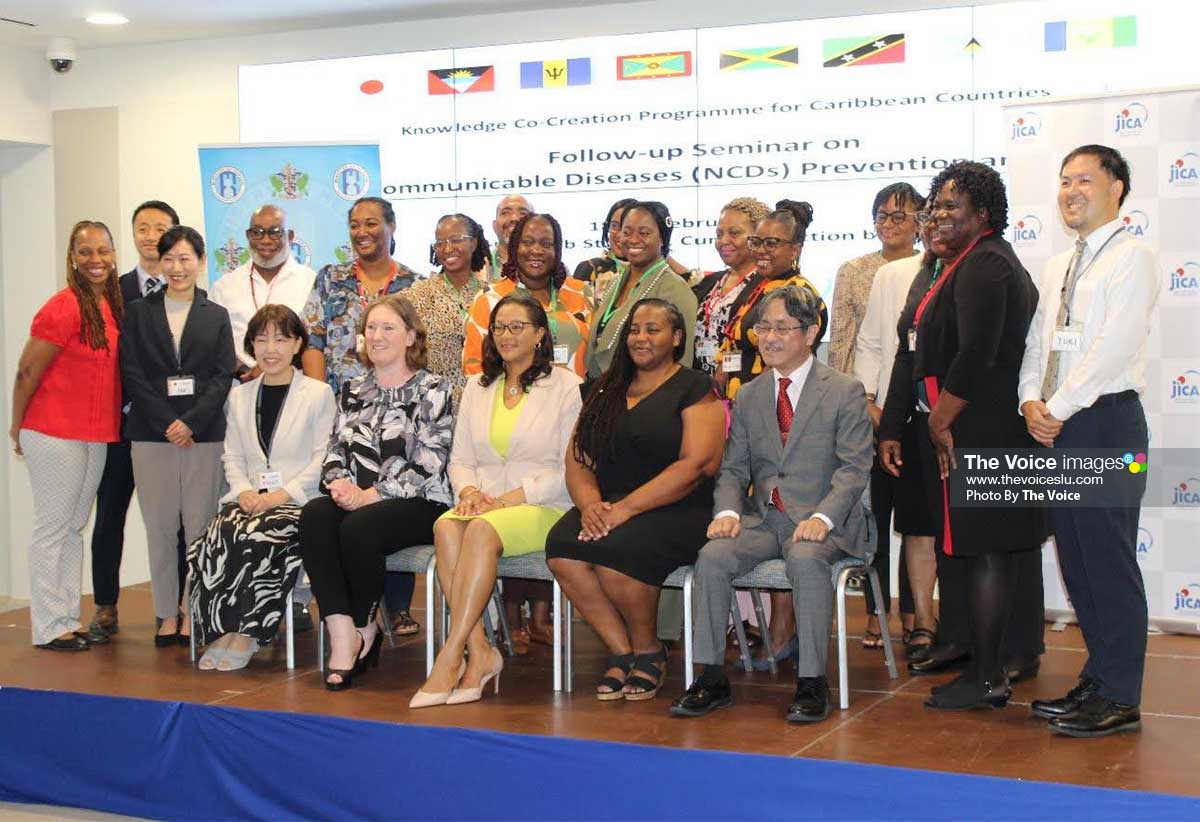
This week, key stakeholders from the sub-region and further afield gathered for a comprehensive three-day seminar organized by the Japan International Cooperation Agency (JICA) to address the issue of Non-Communicable Diseases (NCDs) impacting residents and communities.
The workshop was designed to develop solutions for managing chronic health issues across the Organization of Eastern Caribbean States (OECS) and the wider region, with participation from at least nine countries.
Hiiohito Takata, Director of JICA Saint Lucia, emphasized the importance of addressing regional challenges related to healthcare. He noted that this seminar continues a journey that began a year ago when a group of participants visited Japan in January, followed by a second cohort in August.
“This seminar provides a first-hand update on the challenges and successes of individual programs and their contributions to this initiative,” he stated during the opening ceremony at Harbor Club, Rodney Bay.
Takata outlined that the NCD challenge is part of a broader regional cooperation effort, covering six priority areas: education, health, climate change, private sector, agriculture and fisheries, and collaboration with CARICOM. He stressed the serious health risks posed by NCDs, highlighting their social and financial impacts and the need for research and shared cooperation and information to combat them.
Dr. Sharon Belmar-George, Saint Lucia’s Chief Medical Officer, highlighted that NCDs are a principal cause of morbidity in the country and the region. She acknowledged the support of the Japanese Pro-Creation Project and the contributions from the nine Caribbean countries involved in the NCD strengthening program.
“NCDs are our leading causes of morbidity and mortality, contributing significantly to hospitalization and early deaths,” Dr. George noted.
Yuki Takano, Programme Formulation Advisor with JICA Saint Lucia, spoke about the seminar’s objectives, stating, “This seminar focuses on NCDs, and JICA has been providing technical cooperation, now specifically targeting the Caribbean region.”
He emphasized that this program aims to improve the capabilities of participants trained in Japan, enhancing their action plans to combat NCDs, which account for over 80% of deaths in the region.
Takano mentioned that JICA is engaging major health officials and community personnel to gather information on local plans and ensure that the program encompasses both policy and community engagement.
Dr. George added that JICA is working with nine countries—Barbados, the OECS, Trinidad and Tobago, and Jamaica—to assess, review, and train professionals on improving chronic NCD management in the region.
Utilizing the Japanese model, several cohorts have visited Japan over the past two years to learn from its health system and policies. She expressed satisfaction with the visits, describing them as practical and insightful.
Dr. George emphasized, “Non-communicable diseases (NCDs) are the primary cause of morbidity and mortality in our population, leading to increased hospitalization and utilization of primary care services. They also contribute significantly to years of life lost due to amputations and premature deaths.”
She further said, “Our data across the region reveal many similarities. Through the JICA network, we have studied Japan, a country that has effectively managed these diseases through strategic national policies.”
“Japan is a model of longevity and low NCD rates, and our local health personnel have developed realistic measures we can implement. This initiative is timely for Saint Lucia, especially as we advance towards Universal Health Coverage and strengthen our approach to preventable diseases,” Dr. George concluded.