


Under the theme “Connect, Engage, Align: Optimizing Central Banking Communication and Strengthening Partnerships,” the Eastern Caribbean Central Bank (ECCB) brought together media practitioners from across the Eastern Caribbean Currency Union (ECCU) for a two-day workshop focused on improving collaboration and strengthening public communication.
Delivering the welcome address, ECCB Deputy Governor Dr. Valda F. Henry said the theme is “not simply aspirational, it is intentional,” as the region navigates an era of rapid information flow and increased scrutiny of public institutions. She emphasized that effective communication is inseparable from institutional strength and central to that communication, she noted, is the ECCB’s partnership with the region’s media.
Addressing the first pillar—connecting—Dr. Henry pointed to the ECCB’s role in maintaining regional stability. She pointed to a significant milestone on the horizon: the 50th anniversary of the E.C. dollar peg to the U.S. dollar, established on July 7, 1976, at a fixed rate of 2.70.
This achievement, she explained, has anchored confidence, preserved value, and supported economic resilience across member states. However, its success did not occur in isolation. It was built on clear communication, consistent policy direction, and shared understanding among the ECCB, governments, markets, and the public.
The Bank signaled its intention to collaborate closely with media partners in commemorating this milestone, reinforcing the importance of storytelling in preserving and promoting regional economic history.
Turning to engagement, the second pillar, the Deputy Governor called for a deeper, more intentional approach, one that is inclusive and evidence-based. Drawing on the ECCB’s research agenda, she outlined key regional challenges, including productivity constraints, financial inclusion gaps, and the need to harness opportunities in digital transformation and climate resilience.
She stressed that policy effectiveness depends heavily on public understanding and participation and in this context, media practitioners play a critical role not merely as conveyors of information, but as interpreters and educators.
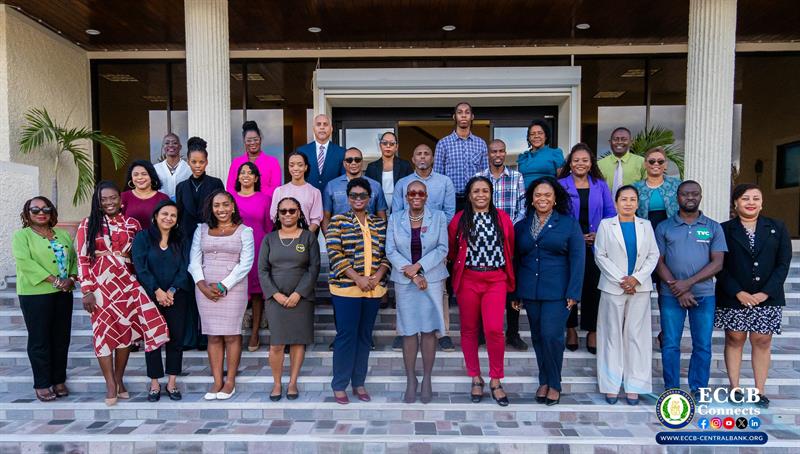
“Your work shapes public perception, influences behaviour, and strengthens accountability,” she noted, urging participants to prioritize clarity, accuracy, and context in their reporting. Through effective engagement, citizens are better equipped to make informed financial decisions and participate meaningfully in economic life.
The third pillar, alignment, focused on the ECCB’s forward-looking agenda. The Deputy Governor announced the launch of the Bank’s Strategic Plan 2026–2031, themed “Collective Action for Shared Prosperity.” This plan will guide the region’s development efforts, with a strong emphasis on growth, resilience, and improved quality of life.
At the heart of this vision is the ECCB’s “Big Push”, a bold strategy centered on the theme Collective Action for Shared Prosperity, which is designed to spur economic growth, strengthen resilience, and enhance the overall well-being of people across the Eastern Caribbean.
The address outlined several “theatres of transformation” critical to achieving this vision, including financial sector development, human capital enhancement, food and nutrition security, climate resilience, energy security, tourism, digital transformation, and logistics.
A central theme was the shift “from savers to investors.” While acknowledging the region’s culture of saving, the Deputy Governor pointed out that sustainable wealth creation requires a broader mindset, one that embraces investment, innovation, and participation in capital markets.
This cultural shift will be supported by key regional institutions, including the Eastern Caribbean Home Mortgage Bank, the Eastern Caribbean Stock Exchange, and the Eastern Caribbean Securities Regulatory Commission, all of which continue to play vital roles in deepening financial markets and protecting investors.
Additionally, new initiatives such as the Office of Financial Conduct and the Eastern Caribbean Financial Stability Board are expected to strengthen consumer protection and regulatory oversight across both banking and non-banking sectors.
Throughout the address, a recurring message was clear: meaningful transformation cannot occur without effective communication. Media practitioners were called upon to demystify complex financial concepts, build public confidence, and encourage greater participation in economic opportunities.
The Deputy Governor emphasized the need for a more dynamic partnership, one characterized by dialogue rather than one-way dissemination. She encouraged journalists to actively engage with the ECCB, ask questions, and leverage the Bank as a resource to enhance their own capacity.
With communication positioned as a cornerstone of development, the workshop marked another step in aligning institutions and media toward a shared vision of stability, growth, and prosperity for the Eastern Caribbean.