


“If we do not pay attention to these changes and ensure that we have an effective system, it means that Saint Lucia can be found on a grey list somewhere.”

The National Anti-Money Laundering Oversight Committee (NAMLOC) and the Caribbean Financial Action Task Force (CFATF) hosted a two-day training session this week to prepare Saint Lucia for the 5th Round Mutual Evaluation commencing 2027-2028.
The high-level session brought together policymakers, regulators, supervisory authorities, law enforcement officials, prosecutors and members of the Judiciary to deepen national understanding of the updated FATF Recommendations and Methodology for assessing technical compliance and effectiveness on money laundering, proliferation financing and financing of terrorism.
“When we are going to be assessed there’s [going to be] a greater focus on how effective Saint Lucia is in terms of investigations… and that’s why the Judiciary is an important part of this discussion,” Chairperson of NAMLOC, Juliana Alfred, explained.
Alfred told THE VOICE that “While people may think this is highly technical and disconnected from them, it’s not, because ultimately if we are grey listed… it’s going to affect employees throughout the country.”
“If we do not pay attention to these changes and ensure that we have an effective system, it means that Saint Lucia can be found on a grey list somewhere,” she added.
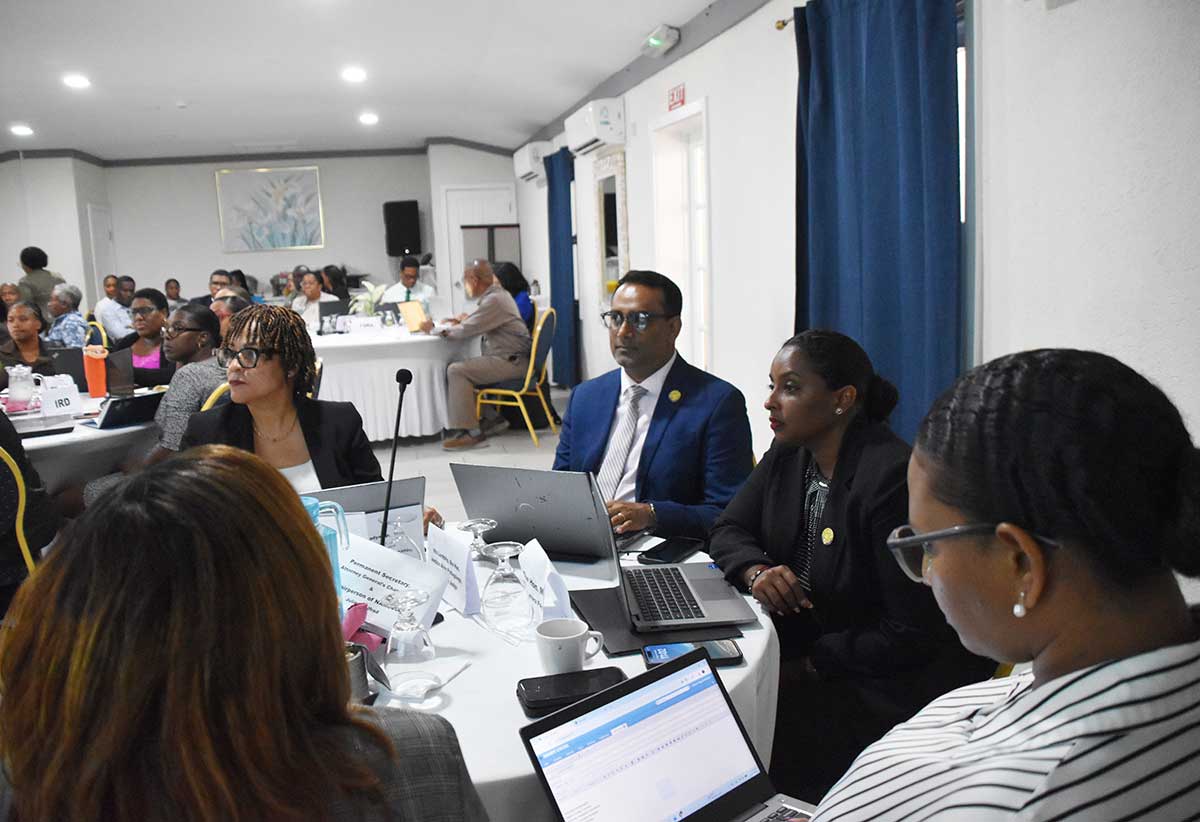
Participants benefited from practical, scenario-based discussions designed to enhance institutional readiness and improve inter-agency coordination. Emphasis was also placed on evidencing outcomes, strengthening supervisory frameworks, and ensuring that legislative and operational measures align with international standards.
“We’re a lot better now because we’re now at 35 over 40 because we’ve worked on some of the areas of concern. We want to remain very good in 2028 and to remain very good we have to do all of these things that we are doing now,” she stated.
The two-day training session was held on March 11th-12th at the Bel Jou Hotel.
A Deeper Look at the FATF’s Mutual Evaluations
FATF mutual evaluations are in-depth country reports analysing the implementation and effectiveness of measures to combat money laundering, terrorist and proliferation financing. The reports are peer reviews, where members from different countries assess another country. Mutual evaluations provide an in-depth description and analysis of a country’s anti-money laundering and counter-terrorist financing system, as well as focused recommendations to further strengthen its system.
During a mutual evaluation, the assessed country must demonstrate that it has an effective framework to protect the financial system from abuse.
Mutual Evaluations have two main components, effectiveness and technical compliance.
The most important part of a mutual evaluation is a country’s effectiveness ratings. This is the focus of an on-site visit by a team of experts to the assessed country. During this visit, the assessment team will require evidence that demonstrates that the assessed country’s measures are working and delivering the right results. What is expected from a country differs, depending on the money laundering, terrorist financing and other risks it is exposed to.
The assessment of technical compliance is also an important part of a mutual evaluation. The assessed country must provide information on the laws, regulations and any other legal instruments it has in place to combat money laundering and the financing of terrorism and proliferation.
The mutual evaluation report is an assessment of a country’s measures to combat money laundering and the financing of terrorism and proliferation of weapons of mass destruction. This includes an assessment of a country’s actions to address the risks emanating from designated terrorists or terrorist organisations. The mutual evaluation report is without prejudice to the status or justification that led to the designation of an entity as a terrorist or terrorist group or organisation.
The FATF conducts peer reviews of each member on an ongoing basis to assess levels of implementation of the FATF Recommendations, providing an in-depth description and analysis of each country’s system for preventing criminal abuse of the financial system.