


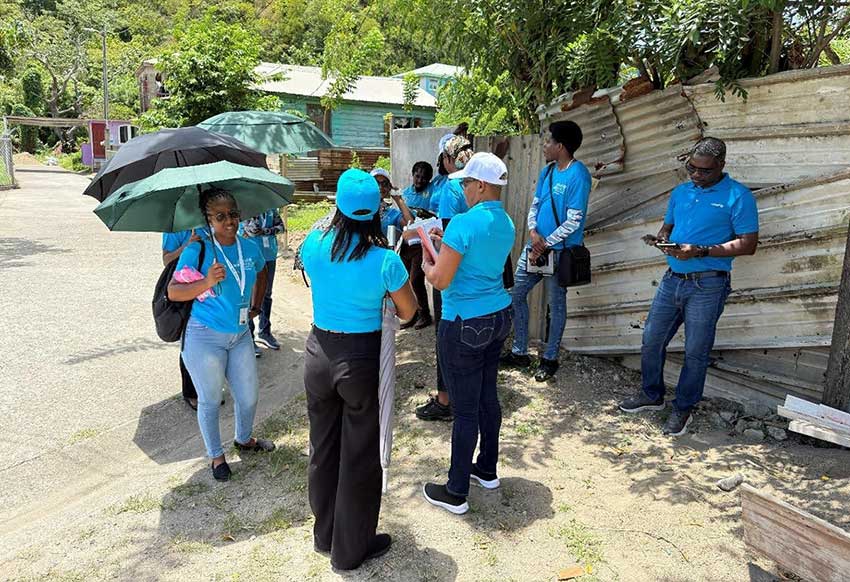
Saint Lucia has successfully concluded the field data collection phase of its 2nd round of the Multiple Indicator Cluster Survey (MICS-7), marking a significant milestone in the country’s commitment to evidence-based development and data-driven policymaking.
The survey, conducted by the Central Statistical Office (CSO) in collaboration with the Ministry of Equity and with technical and financial support from UNICEF, gathered nationally representative data from a scientifically selected sample of 3,040 households across the island.
Urmain Gray, Statistician at the Central Statistical Office and MICS-7 Technical Coordinator, described the completion of fieldwork as a major national accomplishment, particularly given the challenging conditions under which it was executed.
“Concluding this phase of data capture is very significant for Saint Lucia. We have substantial data gaps in several areas, and completing this survey allows us to fill those gaps and support upcoming data initiatives. Despite conducting fieldwork during a general election period and the Christmas season, we remained determined and were able to meet our December 2025 target.”
Ms. Gray explained that the MICS-7 implementation required extensive coordination and technical oversight spanned stakeholder consultations, customization of survey instruments, recruitment and training of enumerators, field supervision, data processing, report writing, editing, and dissemination.
The fieldwork was managed by a 17-member logistical and technical team comprising representatives from the Central Statistical Office, the Ministry of Equity, and the MICS Consultant. Enumerators underwent 28 days of training across the northern and southern regions of the island and participated in UNICEF-led workshops overseas to master the electronic data collection platform used on tablet devices.
Technical collaboration extended from the Ministry of Health, which provided support for child measurements and nutrition components, and UNICEF, which assisted with water quality testing modules. The exercise was further strengthened by a comprehensive public sensitization and awareness campaign to encourage participation. While initial phases encountered minor logistical challenges, particularly during the Christmas 2023/2024 mapping and listing stage and isolated payment delays, the project maintained strong momentum throughout 2024 and 2025, at times advancing ahead of schedule.
The survey instruments were digitally embedded with validation filters and enabling conditions to reduce enumerator error and ensure data integrity. Supervisors conducted real-time field reviews, sat in on selected interviews, and performed immediate checks of completed questionnaires. An additional editing team at the Central Statistical Office conducted further quality assurance reviews. “Based on the rigorous quality control systems we implemented, we are very confident in the accuracy and reliability of the data collected,” Ms. Gray stated.
MICS 7 captures critical indicators across a wide range of sectors, including health, mental health, education, energy, household demographics, immunization coverage, nutrition, time use, and water and sanitation. While UNICEF’s global mandate prioritizes children and women, Saint Lucia’s seventh round of MICS also includes, for the first time, a dedicated component focused on men.
Importantly, the indicators generated through MICS are internationally comparable, enabling Saint Lucia to benchmark its progress against regional and global standards, including the Sustainable Development Goals (SDGs).
The data, drawn from a scientifically selected household sample, will be made publicly available through the Central Statistical Office’s website by the end of the year. Stakeholders, researchers, and members of the public are encouraged to contact the CSO for further information or data requests.
Ms. Gray also extended appreciation to the households that participated in the survey. “On behalf of UNICEF, the Government of Saint Lucia, the Central Statistical Office and the Ministry of Equity, we sincerely thank all respondents who opened their homes to our teams. Their patience and cooperation are invaluable to strengthening national development planning.”
With the successful completion of the data collection phase, Saint Lucia is now positioned to advance reporting, analysis, and dissemination, reinforcing its national commitment to evidence-based decision-making and inclusive development.
The next phase of the MICS 7 initiative involves preparing the tabulation plan, editing, and scripting to facilitate data processing. These activities will run until the end of the current fiscal year.
Moving further afield, plans include data processing, stakeholder engagement to review outputs, engaging schools and key users, preparing the MICS 7 Report, and the officially launching, all aiming to wrap up by December 2026.